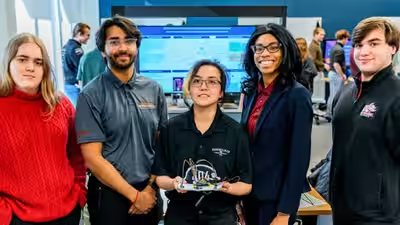
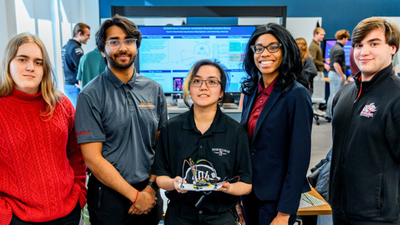
Students at the Rose Hulman Institute of Technology collaborated to create their 2026 design projects aimed at solving everyday problems to improve the lives of people around them. Among them was a team of five who built a 12-hour wearable that helps visually impaired users detect obstacles that their cane or guide dog cannot, as per the institute’s website.Ethan Powell, Anica Cao, Jada Hunter-Hays, Anuj Suvarna and Rhiley Epperson worked with 1983 electrical engineering and mathematics alumnus John Marum to develop the device. The idea for a wearable assisted sight device came from Marum, founder of the non-profit company AuralVision based out of Oakland, California. He was inspired to create a device to help those who are visually impaired using time-of-flight sensors (a form of LiDAR) after seeing how those sensors were being used in airport bathrooms to measure the amount of paper towels left in a dispenser, and how that battery-operated technology made it so custodians did not have to continually check dispensers to know when to refill the paper towels.“I began to think about how it would be possible to use that same sensor to measure distance to objects and relate that distance to someone who can’t see, and then alert them to objects in front of them,” said Marum. He wanted to build a device that was low in cost, battery-operated, and would not require a smartphone connection, paid data plan, or internet connection. He put together a proof of concept and — upon remembering his own senior design experience at Rose — reached out to Rose-Hulman to put the concept to work. The project found a home within ECE 460, a multi-disciplinary, multi-quarter class where students work together to complete their senior design project.“When we first learned of the project, we realised how this idea can really help people,” said Anuj Suvarna, a senior in the Rose Squared program who is simultaneously pursuing his bachelor’s degree in computer engineering (with a computer science minor) and master’s in engineering management. “I’ve really enjoyed being part of a project that has an impact and helps others.” Along with Suvarna, Anica Cao (electrical engineering), Rhiley Epperson (computer engineering), Jada Hunter-Hays (computer engineering and math minor), and Ethan Powell (computer engineering) began work on the project in fall 2025. The students and Marum agree that working together has been an extremely beneficial experience.“Working with Rose has been great and I’ve had such great reactions to the project, from the professors to the students,” said Marum. “The team and I meet weekly to share progress and discuss the problems they’ve encountered and what they learned. The collaboration gives the students a great experience of working with a client, not just a professor.”“The initial information about the program is what drew me in,” said Epperson. “John wanted whatever we design to be open source so it’s available to people to purchase on their own or build on their own and adapt to their own needs and disabilities. That’s a nice challenge and a great goal to work toward.”“When I originally received feedback from my two blind beta testers, they suggested it would be more convenient to simply put a hat on when walking outside,” said Marum. “I sent that feedback to the team, and they wrote a proposal to create a hat version of the device with haptic feedback that would include sensors that rest on the forehead and vibrate to indicate distance and direction of detected objects.”The result was a baseball hat with the time-of-flight sensors built on a strip that easily clips onto the hat’s rim and the haptic feedback sensors vibrate inside the hat to help visually impaired people detect upcoming obstacles. Their device uses a battery system that is built into the chip and lasts approximately 12 hours. It can be used anywhere and is completely self-contained, without requiring software updates or a WiFi connection to function.Through the process of user feedback, the team also learned how to think beyond their own ideas and limitations to create a product that will serve a larger community. Hunter-Hays and Powell conducted a focus group with sight-impaired residents at a Terre Haute assisted living community to seek their input on the device. The individuals, ages 70 to 99, provided helpful feedback such as whether the haptic vibrations may be distracting to some users.“We definitely learned we need to think outside our age range when designing products like this,” said Powell. “Our generation has grown up with an oversaturation of information. So having something constantly buzzing with multiple sensors around the head is normal to us. But for a more elderly user, that may cause confusion or headaches. The next iteration of this project could be to design around that feedback and give other options, for example changing the type of vibration pattern.”All five seniors will graduate after the winter quarter. However, the project will continue through Marum and the ECE 460 course. The team left recommendations for the next cohort of students to continue refining the device. Marum will work with that team, and he hopes other Rose-Hulman alumni with similar needs may want to get involved in this project to hopefully bring it to production and market in the future.