

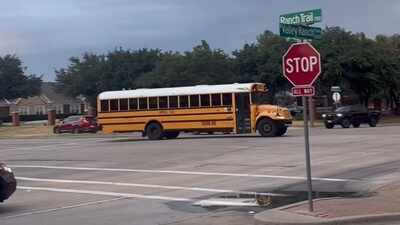
A traffic rule in the US has caught the attention of Indian social media users after an Indian woman living there explained what motorists are expected to do when a school bus stops. Her video has opened up a conversation about road safety, fines, and how traffic rules can differ between countries.Ritu Gupta, who shares videos about her life in the US and talks about various rules there, spoke about the rule in an Instagram video. The clip has received more than 7.3 million views, with many users discussing whether a similar approach should be followed in India.
The US school bus rule
According to Gupta, motorists have to stop when a school bus stops for children and activates its red lights and stop sign.This applies to traffic on both sides of the road. Drivers are expected to remain stopped while children are boarding or getting off the bus.“In America, there is a rule for school buses: when children are boarding or getting off, and the bus comes to a stop, it activates a stop sign and flashes red lights. At that point, traffic on both sides of the road has to stop,” she said.Even vehicles coming from the opposite side must waitGupta explained that the rule also applies to vehicles approaching the bus from the other direction when there is no divider on the road.ID@undefined Caption not available.She pointed out that motorists cannot use the open space on the opposite side to drive ahead while children are near the bus.“You can see children getting on from this side, and even though there is plenty of space for vehicles to pass on the other side, no one moves their car. Since there is no divider in the middle of the road, traffic coming from the opposite direction has to stop as well,” she said.
Illegal passing can bring Rs 94,490 fine
Gupta compared the rule with India, where motorists often try to pass a stationary bus when there is enough room.She said illegally passing a school bus in the US can lead to a fine of $500 to $1,000, which is around Rs 47,245 to Rs 94,490.She also said that such a violation can result in action against a driver’s license, while repeated offenses can lead to punishment.Sharing a warning for viewers, Gupta wrote in her caption, “America me School Bus Ko Bhool Ke Bhi Cross Mat Kar Dena!”She added, “Yaha school bus ko illegally pass karna bahut serious offence hai …fine to lagta hai, license par bhi action ho sakta hai, aur baar-baar violation hua to saza bhi ho sakti hai.”
Social media debate over India
The video also prompted users to discuss whether India needs a similar rule for school buses.One user commented, “Priority education; that’s why it is a developed nation with more intelligent students.”Another said, “Absolutely, India me bhi hona hi chahie.”An individual wrote, “The only thing needed to develop india is strict rules, nothing else.”However, another user said India’s traffic conditions would also need to be considered before applying the same approach.The commenter wrote, “India has 13 times more population density; itne mein kai km ka jam lag jyga… same rule blindly follow nhi hote dusri countries mei, terrain, traffic density bhi dekhni padti hai…Solution kuch aur ho sakta hai, but hona chahiye for safety.”Disclaimer: This article is based on information shared in an Instagram video and social media comments. The Times of India has not independently verified the claims made in the video or the comments.Thumb image: Instagram