
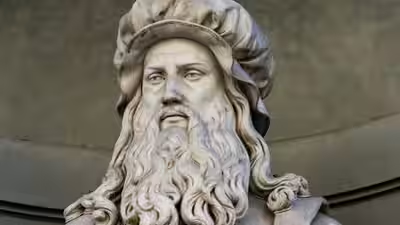
Leonardo da Vinci was an Italian Renaissance thinker, painter, sculptor, architect, mathematician, and engineer, who is popularly known for his exceptional works like the Mona Lisa and The Last Supper.But what makes his life even more interesting is the thousands of pages where he wrote and thought about novel ideas and thoughts which perhaps made his life more captivating after he passed away.He once talked of a profound idea that the inspiration behind our work or good ideas rarely comes when we are at our desk, staring at a screen and forcing it, they possibly hit the mind while we are either walking, washing dishes, waiting for a bus, or looking out of a window. Ideas has a funny habit of turning up when we stop chasing them.Yet most of us feel guilty when we pause. Isn’t that strange?Let’s dig in to find out what he exactly said and meant.
Quote of the day
Men of lofty genius sometimes accomplish the most when they work least, for their minds are occupied with their ideas and the perfection of their conceptions, to which they afterwards give form
Leonardo da Vinci
What does the quote mean?
Leonardo says that people of great genius sometimes achieve the most when they seem to work the least. Their minds are busy with ideas and with refining them, and afterwards they give those ideas a form. So, he meant to say that thinking is real work, even when nobody can see it.The line is nearly always credited to Leonardo, yet it does not come from his own notebooks. It comes from Giorgio Vasari’s Lives of the Artists, which describes Leonardo painting The Last Supper in a Milan convent. Vasari kept coaxing him to finish because Leonardo would sometimes stand lost in thought for half a day. He then complained to the Duke, who gently urged Leonardo to work. Leonardo then explained that great minds sometimes accomplish the most when they work least, seeking out ideas that the hands later express.But it is important to note that Vasari was born in 1511 and Leonardo died in 1519, so Vasari was retelling a story he had heard, not one he saw, and an actual version of his account has been translated over the years, but the essence of his advice has hardly aged.Making anything good has two stages: imagining and doing.It is interesting that the ‘doing’ part, like a brush on a wall, is the part people see, gets the credit. But the imagining that happens quietly in the head rarely does, and Leonardo’s point was that rushing the quiet part spoils the result.
How are his words relevant today?
We often reward and appreciate those people who look busy, and feel guilty when we do not do anything productive. Many workplaces still count hours instead of results. Yet most of us have noticed that the answer to a stubborn problem often arrives in the shower, on a walk, or after a night’s sleep.So the next time you feel guilty for pausing, ask yourself: am I avoiding the work, or preparing for it!