

The author is CEO of PaisabazaarWhen it comes to choosing between UPI and credit cards, consumers should look at the overall value that they can derive from each payment method rather than the immediate cost of the transaction. While UPI provides convenience and simplicity, credit cards offer cashback, rewards and additional perks. With MDR on higher-value UPI transactions now being discussed, understanding the complete economics of a transaction becomes even more important.The overall value of a transaction depends on several factors including the payment mode, transaction value, the applicable MDR (if any), and the value-back attached to the payment method. This becomes particularly relevant as UPI increasingly intersects with the credit card ecosystem through RuPay credit cards.
UPI and cards serve different purposes in the consumer wallet
When a consumer makes a UPI payment from a bank account, the money is deducted directly from the account. While this offers simplicity and convenience, such payments generally do not come with any meaningful rewards, apart from occasional merchant-specific offers.A credit card changes this equation. The consumer can make the purchase today and get an interest-free period of 40-50 days, depending on the card’s billing cycle and payment terms. Moreover, when it is a RuPay Credit Card that supports UPI payments, this flexibility is combined with the convenience of UPI.
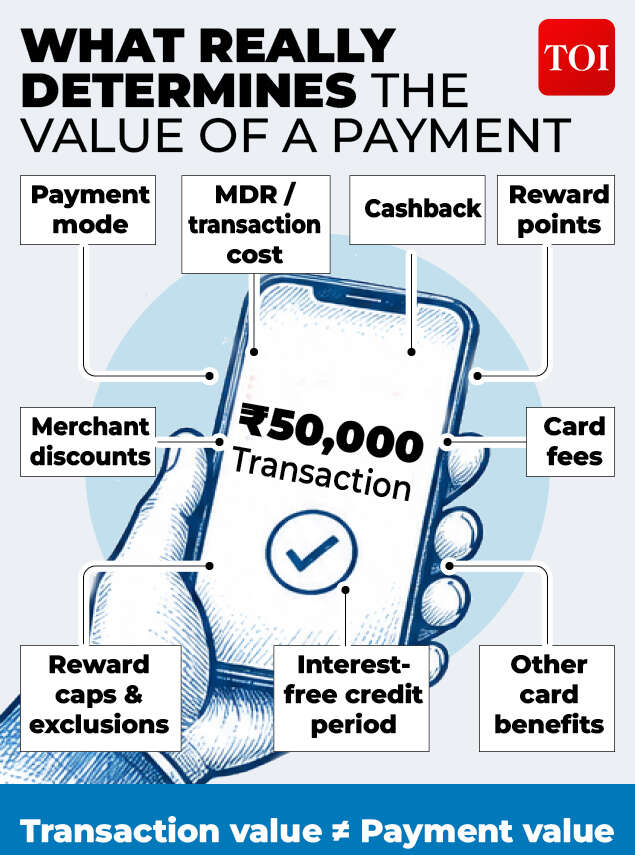
What determines value of a payment?
Value-back as rewards or cashback can change the economics
Credit cards are increasingly being designed around specific spending behaviours. Depending on the card, consumers can earn cashback or reward points on categories ranging from everyday purchases to high-ticket spends like travel bookings and electronics.Consider a Rs. 50,000 transaction on a card offering 5% cashback on the spend. The consumer could potentially receive Rs 2,500 back, subject to the card’s terms, redemption value and applicable caps. Now if the consumer chooses to pay the same amount through UPI and the merchant passes on the entire MDR cost of 0.4% to the consumer, they will end up paying an additional Rs 200, making the product costlier for them, with no additional benefits.In fact, in most scenarios, credit cards can offer greater value to consumers through rewards, cashback and other benefits, without any additional payment processing charges being levied on them. However, this holds true only if consumers pay their credit card bills in full and on time, avoiding interest or finance charges. Once interest starts accruing on outstanding balances, it can outweigh the value earned through rewards or cashback, potentially nullifying the benefits of using a credit card.This is why comparing payment methods purely on the basis of transaction charges like MDR could be misleading. Rewards, offers and other value-back systems should also be taken into account. At the same time, a card may carry an annual or joining fee, impose reward caps, exclude certain categories, or offer a lower reward rate on certain transactions – which should also be considered.
Transaction size alone does not determine the better choice
A common assumption is that UPI is best suited to small purchases while cards make more sense for larger transactions. However, in practice, the answer is more nuanced.Even a small Rs 500 transaction on a credit card could be more valuable than the same transaction through bank-account UPI if the card offers meaningful cashback or rewards on that particular spend. Conversely, a Rs 50,000 transaction may not necessarily justify the use of a credit card if the transaction falls outside the card’s reward categories or has already exhausted the applicable monthly reward cap.Consumers should, therefore, look at the frequency of spending and the cumulative rewards generated over time. Small individual transactions can add up to significant value when they form a large portion of monthly expenditure. At the same time, card-specific discounts, cashback, merchant offers and reward points may add further value. Hence, the effective benefit can vary considerably across cards and merchants, irrespective of transaction values.
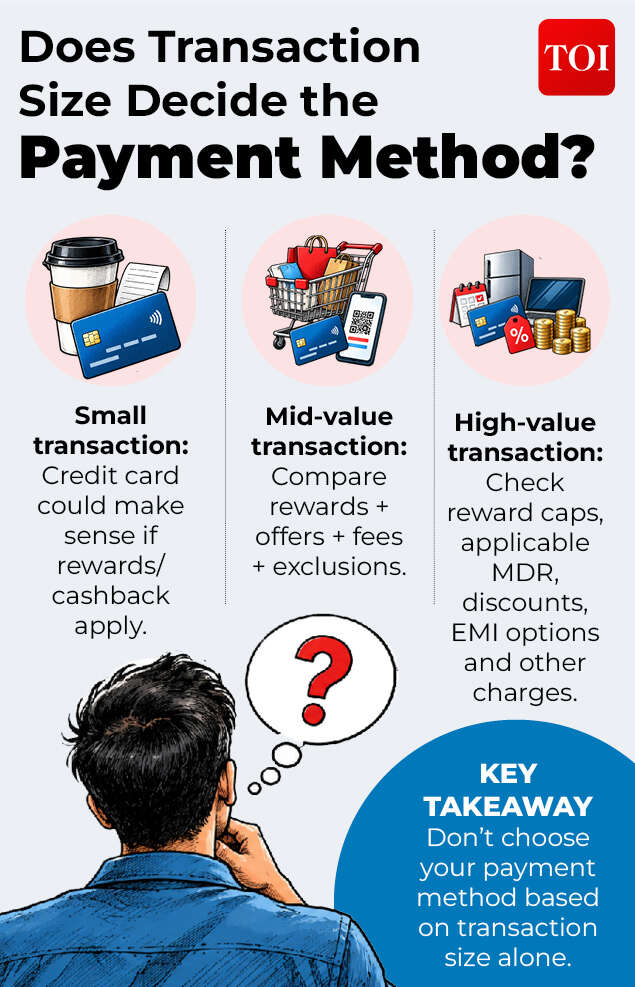
Does Transaction Size Decide the Payment Method?
Credit cards can offer value beyond the immediate transaction
An often-overlooked aspect of credit card payments is that their value is not limited to rewards. For consumers who manage their credit responsibly, the interest-free period can provide useful cash-flow flexibility. Some transactions may also be eligible for EMI conversion, allowing a large purchase to be spread across several months. Credit cards also come with issuer-specific offers, milestone benefits, travel privileges and more.But these benefits only have value when they are actually relevant to the consumer. Paying an annual fee for benefits that are rarely used does not necessarily make economic sense.
The consumer’s spending pattern should drive the choice
Ultimately, there is no single payment method that will offer the best value for every consumer or every transaction. The important shift is to stop looking at payment methods only through the lens of convenience or transaction value and instead consider the net economics of the payment and choose the payment instrument that delivers the most meaningful value for one’s individual spending pattern.
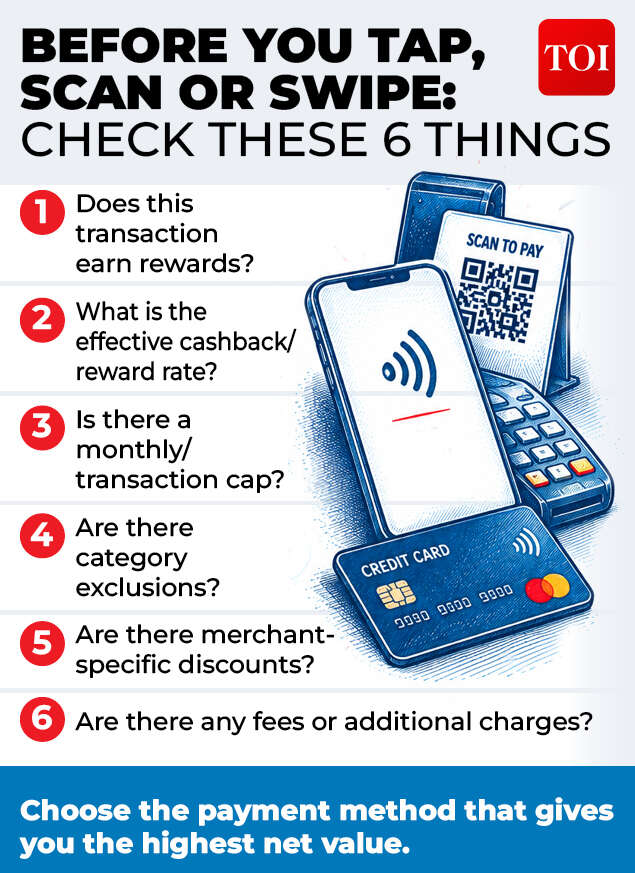
Before you tap, scan, or swipe: Check these 6 things
MDR may change the equation, but not necessarily in the same way for everyone
The discussion around MDR on higher-value UPI transactions adds another dimension to this comparison. MDR represents a cost associated with accepting a digital payment, and the relative economics for merchants can vary across payment instruments and transaction types.The impact on consumers, however, will depend on how the ecosystem responds. If merchants absorb the additional cost, there may be little or no visible impact on the consumer. If the cost is reflected in pricing or an additional payment-related charge, consumers may have to pay it as part of the product’s cost.Whether and to what extent merchants pass such costs on to consumers is yet to be seen.(Disclaimer: Recommendations and views on the stock market, or any other asset classes or personal finance management tips given by experts and analysts are their own. These opinions do not represent the views of The Times of India.)