

“Football is a dream, but isn’t it wonderful if we can help kids to get out of poverty by studying?” Vinícius Júnior posed that question in 2021, when he was just 21 and setting up an institute to bring football and education into Brazil’s public schools. Inspired by the work of LeBron James, Lewis Hamilton and Marcus Rashford, the Real Madrid forward began with a project close to home in São Gonçalo. Two years later, he received the Sócrates Award at the 2023 Ballon d’Or ceremony, recognising his work beyond the pitch. Five years after the institute’s founding, that ambition has grown into an initiative reaching thousands of students, with nearly R$8 million invested in its programmes in 2025 alone.
Why Vinícius Júnior started his institute at 21
Vinícius was born in São Gonçalo, a municipality in Rio de Janeiro where opportunities for children from underprivileged backgrounds can be limited. His own route into professional football began early, but making that journey work came with a cost, particularly when he started training with Flamengo at the age of 10 and faced a daily commute of around 70 kilometres that affected his education.Football ultimately opened doors for Vinícius, but his own journey also showed him how difficult it could be for children from communities like his to access opportunities beyond sport. Speaking to The Guardian in 2021, he explained the thinking behind his initiative: “My first concern was to help these young kids to achieve more via education. Football is a dream, but isn’t it wonderful if we can help kids to get out of poverty by studying?” His ambition, he said, was to create lasting change: “We need to have more doctors, lawyers, engineers coming out of the favelas. We intend to give opportunities to them.”
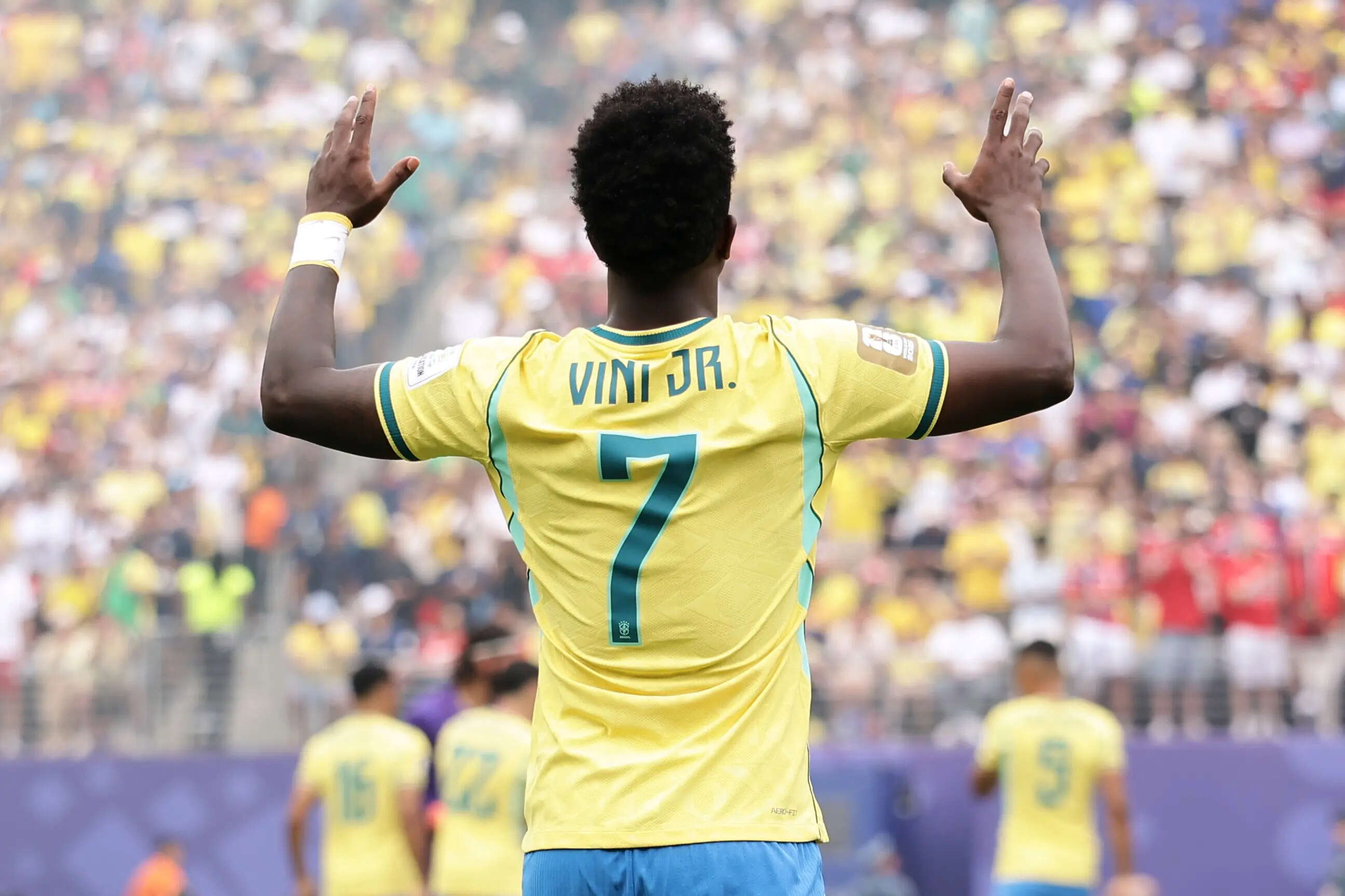
Brazil’s Vinicius Junior (7) gestures ahead the World Cup round of 16 soccer match between Brazil and Norway in East Rutherford, N.J., near New York, Sunday, July 5, 2026. (AP Photo/Adam Hunger)
In October 2021, Vinícius founded the Instituto Vini Jr., financing the initiative himself and starting with a project at the school he had attended as a child. He had long felt he could do more beyond football, and the institute gave him a way to put that belief into practice.“There is still a huge gap in literacy in Brazil. It’s good that we launched the app in the school where I studied because I knew how it was.”For Vinícius, the initiative especially presented a chance to turn that conviction into action. “I just thought that I could do more and I’m doing moreInspired by athletes who had used their platforms to address social inequalities beyond sport, Vinícius looked to LeBron James, Lewis Hamilton and Marcus Rashford as examples of what that commitment could look like.“I’ve been inspired by what LeBron James, Lewis Hamilton, and Marcus Rashford are doing. So, I began doing something for my neighbourhood first, but who knows if it can grow across Brazil,” Vinícius told The Guardian in an interview marking the institute’s launch.James had established a school supporting children through education and other services, Hamilton had supported greater diversity in science and technology, while Rashford had campaigned against child food poverty. Vinícius saw examples of how athletes could use their influence and resources to tackle problems that extended far beyond their own careers.His idea was to bring that thinking into Brazilian public education, using football as a familiar starting point to help children learn and give teachers better tools to engage their students.
How football became a teaching tool inside Brazilian classrooms
The Instituto Vini Jr. does not operate as a conventional football academy, because its central purpose is to improve public education through teaching methods that combine technology, physical activity and the language of the sport children already understand.One of its main initiatives is BASE, a gamified educational application designed for primary-school pupils aged six to 10. The app uses football-themed exercises, interactive activities and player-inspired imagery to teach core subjects such as mathematics, Portuguese and social sciences, while its August 2026 update aligned the programme with Brazil’s national curriculum standards.The institute also works directly with schools through its CT Base innovation hubs, which provide technological tools, classroom infrastructure and support for teachers adopting digital learning methods. Its Mov.A programme takes a different route, using movement and physical coordination to help children engage with their regular school subjects.These initiatives address a wider problem facing Brazilian education, where access to private schooling and the resources it can provide remains unequal. The institute works with public-school teachers to understand what their students need, then adapts its methods to local realities rather than imposing one approach across every classroom.The organisation now reports that its programmes reach more than 10,169 students across over 30 schools in five Brazilian states, building on earlier work involving approximately 4,500 students and 500 teachers. Its stated ambition is to support the UN’s Sustainable Development Goal 4, which focuses on quality education, by helping make public schooling more effective and accessible by 2030.
Nearly R$8 million invested in 2025, with a major project back home
The institute’s latest financial figures give a clearer picture of how much of its work goes directly into its education programmes. During 2025, it invested R$7,996,294.17, approximately US$1.59 million, while allocating 85% of its resources directly to core activities developed with partner schools, teachers and students.In a statement published on August 10, 2026, the institute explained what that allocation means for its work.“In 2025, 85% of the Instituto Vini Jr.’s resources were directly allocated to its core activities, contributing to actions developed with partner schools and reaching teachers and students through new teaching and learning methodologies and strategies.”The statement added that the figures reflected its commitment to transparent, responsible management, with most of its resources directed towards initiatives at the heart of its mission.Vagner Rocha, the institute’s head of Operations, described the satisfaction of seeing those plans become real projects rather than remaining figures in a budget.“I think working with finance and seeing the numbers become reality is always very enjoyable. We think, we project how things will happen, but seeing it in practice, seeing the project actually come to life, following the entire trajectory of what was planned, is very gratifying,” Rocha said.He also explained why the work takes on greater meaning when it reaches the children themselves.“And when you see the children participating in our projects benefiting from everything that was conceived, formulated, and built with so much hard work and care, it brings more energy and gives even more purpose to the work.”One of Vinícius’s most ambitious projects brings that commitment back to São Gonçalo, where the institute is rehabilitating the former Ciep 040 Porto do Rosa Intercultural Brazil-Russia public school building. The Rio de Janeiro state government approved a competitive bidding process granting the institute rights to take over the deactivated site in August 2024, after the school had remained closed for nearly a decade.The redevelopment involves a reported personal investment of approximately €3.3 million to €3.6 million from Vinícius, with plans to create a free social and cultural centre combining educational technology classrooms, sports facilities and communal spaces. The complex aims to serve more than 5,000 residents, giving the surrounding community access to opportunities that extend well beyond the classroom.
The Sócrates Award and Vinícius’s fight against inequality
The scale of that work helped Vinícius become the first and, so far, only Brazilian recipient of the Sócrates Award, which France Football established in 2022 to recognise footballers making a difference through humanitarian work and community initiatives.He received the honour at the 2023 Ballon d’Or ceremony, where he spoke about what the institute meant to him and why he wanted to keep expanding its reach.“Very happy to receive this award and to help many children in Brazil. I had little chance of getting where I have coming from where I came so it is a pleasure for me to help as many kid as I can so they can have a chance.”His work also extends to tackling racism, an issue Vinícius has confronted throughout his career as a Black Brazilian footballer playing in Europe. The institute runs an anti-racism office that provides institutional support, educational workshops and guidance on accessing pro bono legal assistance for discrimination-related cases.In 2024, Vinícius was also appointed a UNESCO Goodwill Ambassador for Education for All, becoming only the second Brazilian footballer after Pelé to receive that honour.The recognition has followed a project that began with one young footballer funding an idea in his neighbourhood and has since expanded into a network supporting thousands of children. For Vinícius, the aim remains tied to the problem he recognised as a boy in São Gonçalo: giving children access to opportunities that allow them to imagine a future beyond the circumstances into which they were born.