
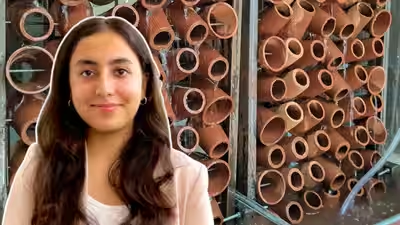
The idea behind Project Vaayu began with a contrast that was difficult to ignore. In April 2024, as a severe heatwave swept across North India, 16-year-old Amaira Kapoor was struggling to concentrate in her own air-conditioned classroom. Nearby, children in government schools were trying to study in rooms with inadequate ventilation and little access to cooling.For the Gurugram student, the question was not just how to beat the heat, but how to make classrooms more comfortable for children who did not have the same facilities.“I was struggling to focus in my own climate-controlled classroom,” is how the experience is described in her profile by Action For Nature, which named Kapoor its 2026 Eco-Hero, awarding her first place in the competition.The experience led to Project Vaayu, an initiative Kapoor founded in April 2024 to develop low-cost cooling systems for under-resourced classrooms. Instead of relying on expensive equipment, the project draws on a familiar material found across India: terracotta.Its cooling units use discarded clay tea cups, commonly known as kulhads, to help bring down classroom temperatures. According to Action For Nature, field testing in government primary school classrooms has recorded temperature reductions of 6°C to 10°C, with the system using minimal electricity.
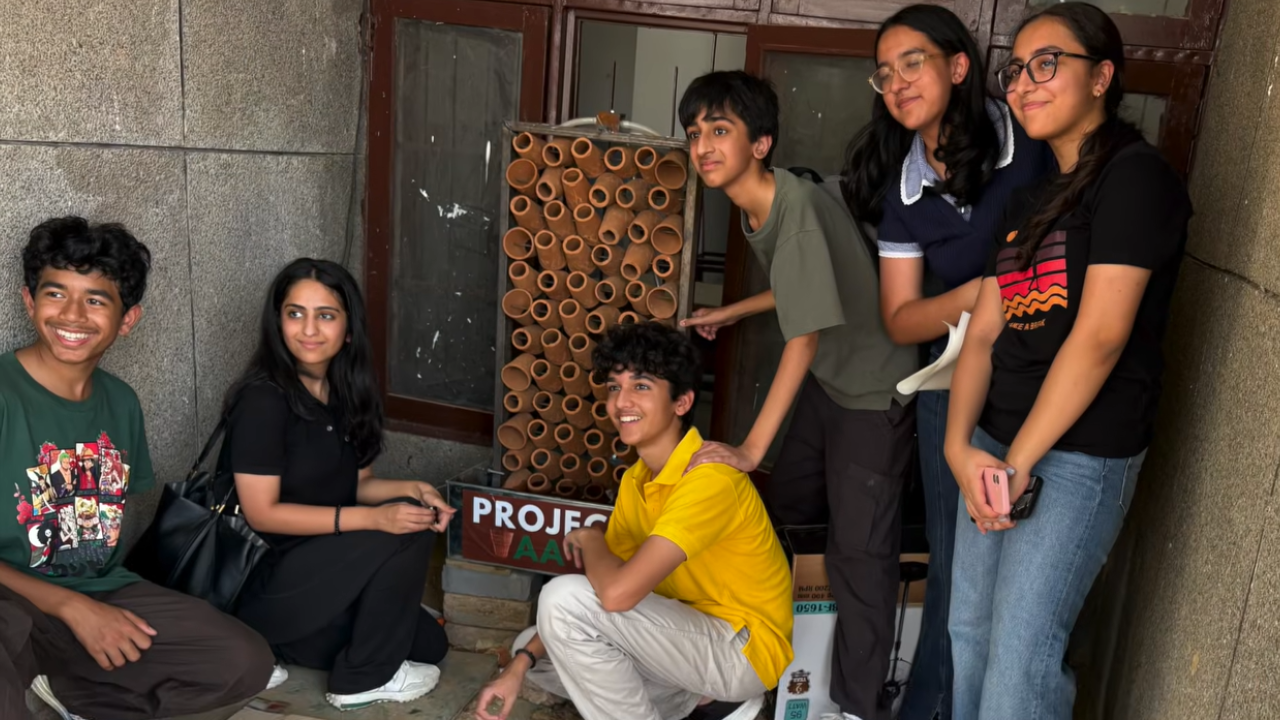
Amaira Kapoor and her six-member team working on Project Vaayu.
From an everyday material to a cooling system
The principle behind Project Vaayu is rooted in evaporative cooling, a process also associated with traditional earthen pots that keep water cool.The team collects discarded terracotta cups from local tea vendors, cleans them and arranges them within a frame. A small pump circulates water over the porous clay. As the moisture evaporates, it cools the surrounding air.The design aims to address two concerns at once: the need for affordable cooling in classrooms and the reuse of materials that might otherwise be discarded.According to Action For Nature, the first versions of the cooler presented practical challenges. Prototypes made with scrap wood developed water leaks and structural problems. Kapoor responded by moving to an iron framework and sealing the joints with silica to improve durability.These changes were important to making the design suitable for use in school environments, where the equipment needs to withstand regular use.The project’s approach is deliberately practical. Rather than depending on sophisticated equipment, it uses readily available materials and a basic water-circulation system. The aim is to offer cooling relief while keeping electricity consumption low.
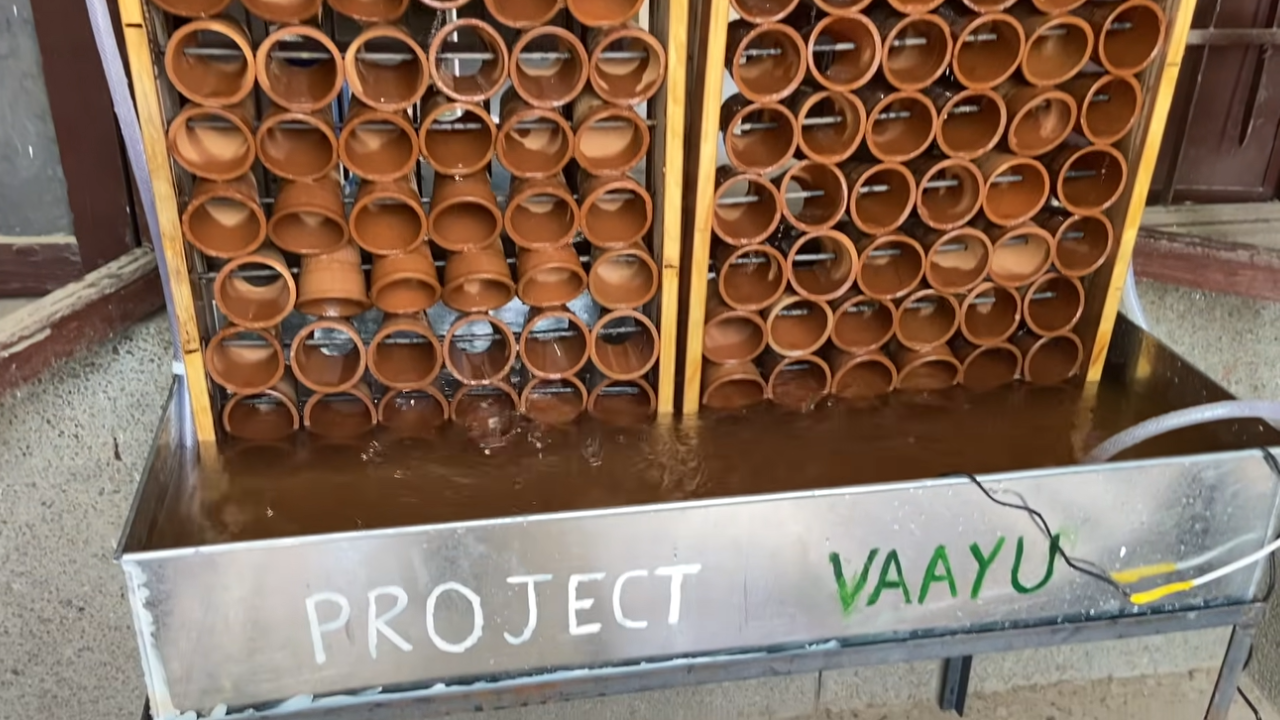
Project Vaayu uses upcycled kulhads and evaporative cooling to lower classroom temperatures.
Why classroom heat became the focus
The problem that prompted Kapoor to act was not simply the discomfort of a hot summer day. It was the difference between the conditions in which students were expected to learn.In its profile of the young innovator, Action For Nature describes how the 2024 heatwave, with temperatures approaching 50°C in parts of North India, made even climate-controlled classrooms uncomfortable. Kapoor began thinking about children attending nearby government schools, some of whom studied in concrete rooms without adequate ventilation, fans or reliable electricity.The profile connects her work to a broader concern: extreme heat can affect children’s concentration and physical well-being, making the classroom environment an important part of the discussion around climate resilience and access to education.Project Vaayu was developed as a response to that gap. The intention was to create a solution that could be installed in schools without the expense and energy requirements associated with conventional air-conditioning systems.
Five coolers across four schools
The project has moved beyond the prototype stage. Action For Nature reports that five cooling systems have been installed across four government primary schools, reaching more than 400 students.The initiative also includes climate-awareness sessions in Hindi, through which younger students are introduced to global warming and lower-carbon approaches to addressing environmental challenges.This educational component gives the project a purpose beyond installing cooling equipment. It introduces students to the science behind the system and shows how discarded materials can be reused to solve a practical problem.According to Action For Nature, Kapoor manages a growing group of more than 20 student volunteers. The wider Project Vaayu initiative has also been documented by HundrED, an organisation that identifies and supports education innovations. Its profile similarly records five installations across four schools and more than 400 children reached.The reported temperature reductions of 6°C to 10°C are a key measure of the system’s performance. However, the results relate to the project’s field testing and should not be taken as a guarantee that every installation will achieve the same reduction under different weather and classroom conditions.
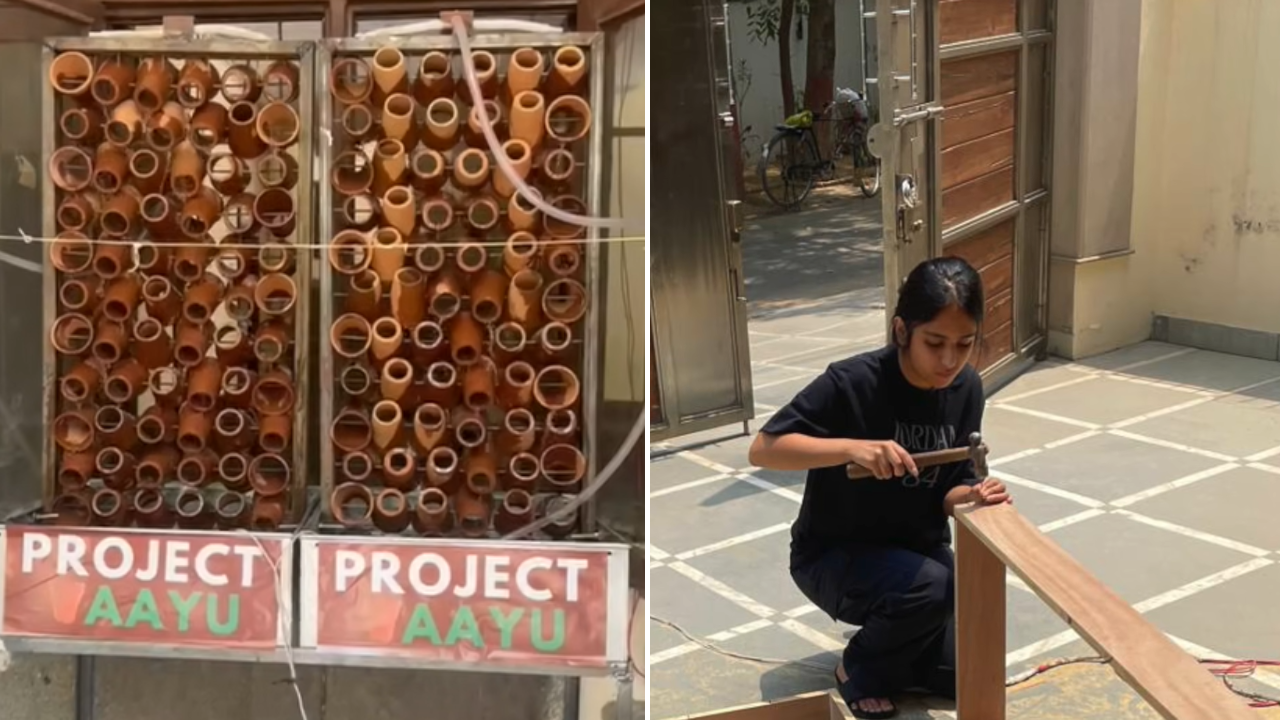
The Gurugram teen’s initiative combines low-cost cooling with terracotta waste reuse.
Recognition for the initiative
Project Vaayu has received recognition through youth innovation and environmental programmes. According to Action For Nature, it secured second place at the South Asia level in the Youth for Earth competition and received a grant of US$730 through Girl Up India’s Pitch Power Planet competition, funded by the United Nations Foundation.Kapoor’s work also extends beyond classroom cooling. Her profile notes that she co-founded Project Khel Kranti, an initiative that reused scrap materials to create sustainable school playgrounds for 300 children.Alongside her environmental work, she participates in competitive athletics and international debating. She has represented Team India at tournaments hosted by Cambridge University and the University of Toronto, according to Action For Nature.The next stage of Project Vaayu involves improving the cooling units and preparing the initiative for expansion. Kapoor is integrating temperature sensors into the systems and training younger student leaders, with the stated aim of taking the project to 15 schools.
Making a design work in the real world
One of the central ideas in Kapoor’s work is that a useful innovation does not have to begin with expensive equipment. It can start with a problem that is visible in everyday life and a material that is already available.Her experience with Project Vaayu also shows that a workable idea needs refinement. Water leakage and structural weaknesses required changes to the original design before the coolers could be used more reliably in classrooms.In her statement to Action For Nature, Kapoor reflects on the relationship between extreme heat, children’s well-being and the need to improve an idea through practical experience.“When temperatures hit 50°C, exposure to extreme heat affects everything: a child’s concentration, physical health, and social engagement,” she says.She adds: “Real impact requires adaptability and persistence; leadership isn’t about getting everything right the first time, but about refining a solution until it works effectively in the real world.”Her broader point is that traditional methods can still have a place in responding to modern environmental challenges. “By utilizing simple, time-tested traditional methods, we can protect the communities most vulnerable to climate change without worsening the global climate crisis,” Kapoor says.For now, Project Vaayu’s work is centred on improving the classroom environment through a relatively simple cooling system. Its next challenge is to expand that work while ensuring the design remains affordable, effective and practical for the schools it aims to serve.