
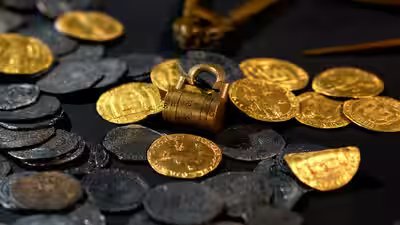
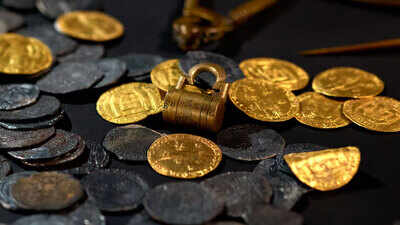
A brass combination lock recovered from a 16th-century shipwreck off the coast of Wales remained unopened for more than four centuries. Researchers from Cardiff University and Amgueddfa Cymru have now solved its four-letter code, ANCE, using CT scanning technology without damaging the historic artefact.The lock belonged to the treasure hoard of the Ann Francis, a ship that sank during a storm on December 28, 1583, while returning from Spain. Its cargo remained buried beneath the sand for centuries before metal detectorist Peter Hughes began uncovering the artefacts at Margam Beach over a period of 21 years, between 1996 and 2017.
How scientists cracked the 400-year-old combination
Rather than attempting to force the lock open, researchers used micro-CT scanning to examine its internal mechanism. The technology produced detailed three-dimensional images, allowing them to study how the internal notches aligned with the letters on the lock’s rotating dials.Dr David Williams, a research associate at Cardiff University’s School of Engineering, carried out the scanning work. He said the technology allowed the team to examine the mechanism without causing damage to the artefact.The scans revealed the correct four-letter combination: ANCE. Museum specialists subsequently tested the code and confirmed that the lock could be opened.Micro-CT scanning is commonly used to study bones and other biological structures. Its application to the Elizabethan lock offered a way to investigate an object that had remained closed for more than 400 years while preserving its original condition.
What was the lock protecting?
Researchers believe the lock may have secured a small chest containing valuable belongings. It was discovered near Spanish silver coins and two coin weights recovered from the shipwreck site.The chest could have contained valuables, documents or textiles, although none of these possible contents has been confirmed. The lock’s association with the dated shipwreck and its unusually good condition make it a particularly significant archaeological find.Alastair Willis, senior curator for numismatics and the Welsh economy at Amgueddfa Cymru, said the discovery had raised another question: whether the combination ANCE held a particular meaning for the person who owned the lock.
How the Ann Francis treasure was discovered
The Ann Francis was caught in a severe storm on the evening of December 28, 1583, while sailing back from Spain. It was blown off course and wrecked near Margam Beach, close to Port Talbot in Wales.Much of its cargo remained concealed beneath the sand until changing coastal conditions, including storms and dredging, exposed traces of the wreck. Metal detectorist Peter Hughes gradually recovered the hoard between 1996 and 2017.Hughes recalled being surprised by the lock’s workmanship and condition when he found it. Its rotating dials could still be moved despite centuries beneath the sand.The lock is among several objects from the Ann Francis hoard displayed at the National Waterfront Museum in Swansea. The collection also includes rare Spanish gold coins from the reign of Ferdinand and Isabella and a boatswain’s whistle recovered from the wreck.The exhibition, Tides of Treasure, is scheduled to remain on display until September 2027.Source: Cardiff University and Amgueddfa Cymru. The four-letter combination was identified through micro-CT imaging and subsequently tested by the museum team.