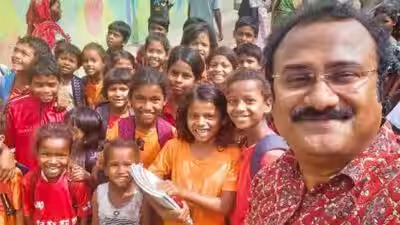
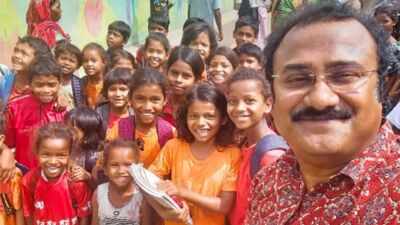
A plate of leftover biryani was supposed to be thrown away. But for one child searching through a garbage dump, it was something to eat. The sight left West Bengal professor Chandrashekhar Kundu deeply disturbed and made him question how food could be wasted when children were struggling to find their next meal. What began as a moment of guilt gradually became a mission that went beyond feeding hungry children. Kundu started collecting surplus food, bringing together volunteers and creating opportunities for children who had little access to education.Today, his initiative, Food, Education and Economic Development (FEED), reaches nearly 180 children with meals and has grown into a network of more than 20 free learning centres. His journey shows how one uncomfortable moment can inspire a lasting effort to address hunger and educational inequality.
A birthday celebration that turned into a life-changing moment
The story of FEED goes back to July 2015, when Kundu was celebrating his son Srideep’s eighth birthday. After the party, there was plenty of leftover food. While disposing of it, Kundu noticed two children searching through a garbage dump for food. One child was picking out pieces of meat from discarded biryani, while the other stood nearby trying to keep stray dogs away. The sight deeply affected him. He brought the children home and arranged food for them, but the incident stayed on his mind long after that night.He began wondering how families could spend money on elaborate celebrations and throw away perfectly edible food while children nearby went hungry. Rather than treating it as an isolated incident, Kundu started researching food wastage in India. He also filed a Right to Information (RTI) request with the Food Corporation of India to understand the scale of the problem. The experience convinced him that even small efforts to redirect surplus food could make a difference to people who struggled to afford regular meals.
From collecting leftover food to building FEED
Kundu started his efforts on a small scale. As a computer science teacher at an engineering college in Asansol, he began carrying containers to the college canteen to collect excess food and distribute it among children living near the railway station. His students and colleagues gradually joined him. They helped collect surplus food from educational institutions, office canteens and other establishments before distributing it to people who needed it.In 2016, these efforts took a more organised shape with the formation of FEED, which stands for Food, Education and Economic Development. The initiative also established partnerships with organisations such as IIM Calcutta, Vesuvius India and the Central Industrial Security Force (CISF) to make food collection and distribution more organised.However, Kundu soon realised that collecting leftover food alone could not solve the problem. Food collected late at night could not always be distributed immediately, and storing cooked meals for long periods raised hygiene concerns. The organisation therefore introduced community kitchens where volunteers and local residents could prepare fresh meals for children.
When a meal became a reason to return to school
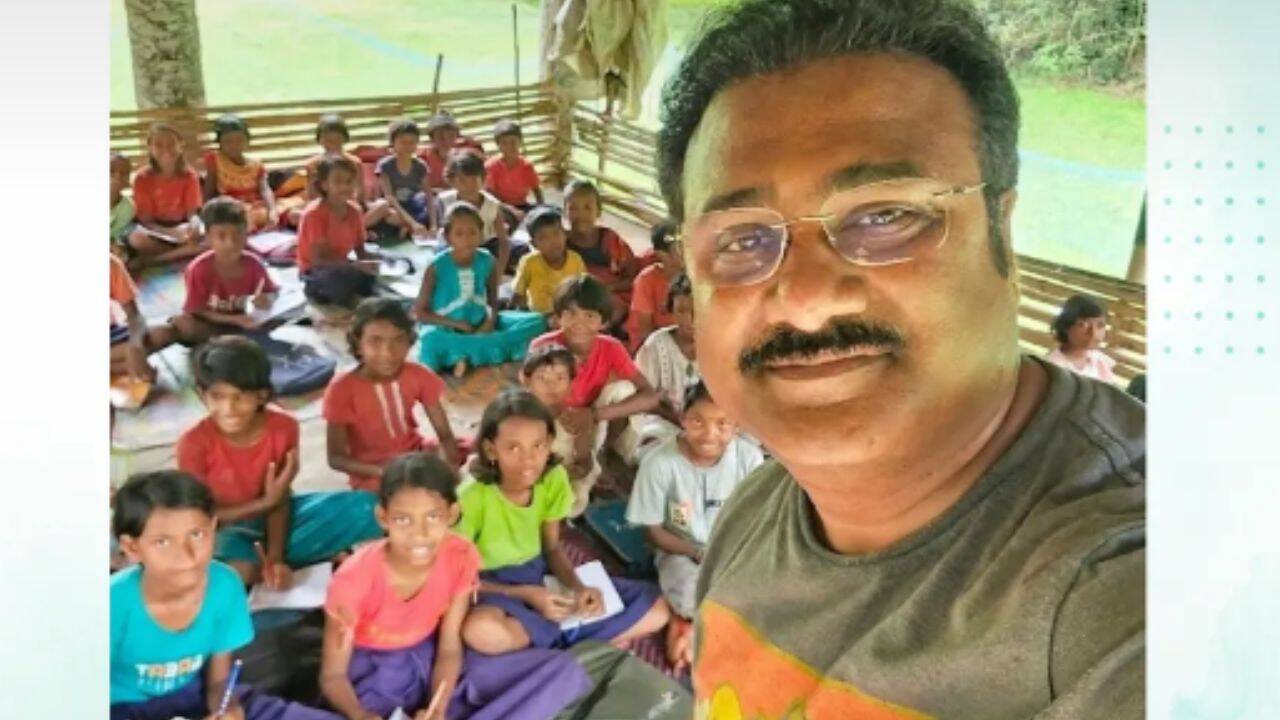
As Kundu and his team spent more time with the children, they discovered that hunger was only one part of their struggle. Many came from families involved in stone quarry work and daily-wage labour. With limited educational support at home, some struggled to keep up with schoolwork, while others were at risk of dropping out. Kundu realised that providing food without addressing their education would leave another important problem unresolved.This led to the creation of ‘Boi Toi Hoi Choi’, FEED’s free coaching school initiative, launched in 2018. The centres provide children with additional academic support, helping them understand lessons they may have missed and build confidence in their studies. One important part of the model is that children receive evening meals alongside their learning support. For families struggling financially, knowing that a child will receive food after attending classes can make a difference.The initiative has gradually expanded across communities in West Bengal. FEED’s official website currently lists 21 functioning coaching schools across the Asansol and Purulia tribal belts, supporting more than 1,200 first-generation learners.
More than feeding hungry children
Today, Kundu’s work has grown beyond food distribution and classroom support. According to The Better India’s November 6, 2026 report, his initiative provides meals to nearly 180 children across three villages. The organisation also runs more than 20 free learning centres. FEED has also introduced programmes focused on girls’ education, sports, self-defence and women’s livelihoods. Its Bengal Tigress initiative trains tribal girls in football, while its Matangini Vahini programme provides karate and self-defence training.The organisation also works with local communities to create livelihood opportunities. Village women are involved in preparing meals at community kitchens, while educated young people are engaged as teachers at learning centres. This creates opportunities for people in the same communities that the organisation is trying to support. For Kundu, the idea has always been to address problems together rather than treat hunger, education and poverty as separate issues.A child who receives a nutritious meal has a better opportunity to concentrate on studies. A child who receives regular academic support has a better chance of continuing education. And when local people become part of the solution, the impact can reach beyond individual families. What began with two children searching through discarded food after a birthday celebration has developed into a wider community initiative. Kundu’s journey is a reminder that meaningful change does not always begin with a large organisation or substantial resources. Sometimes, it begins with noticing something others might walk past and deciding that it should not happen again.