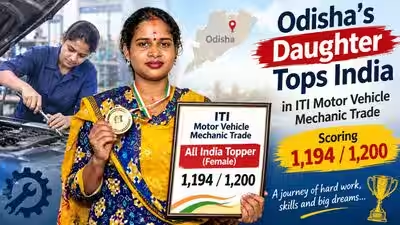
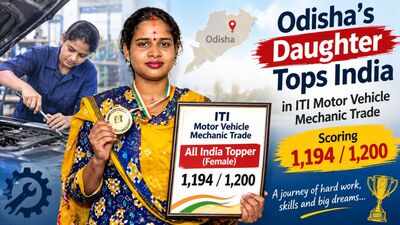
For Supriti Mahapatra, the road to success did not begin in a fancy workshop or behind the wheel of an expensive car. It began in Puri, Odisha, where she grew up in a family whose livelihood is connected to the roads. Today, she has earned national recognition in a field where women remain relatively under-represented, showing that technical skills and ambition have no gender.The daughter of an auto-rickshaw driver, Supriti has emerged as the national topper among female trainees in the Mechanic (Motor Vehicle) trade under the Industrial Training Institute (ITI) examinations. She scored an extraordinary 1,194 out of 1,200 marks, placing her at the top of the list of female candidates across India. Her achievement is more than an academic milestone. It is a reminder that opportunities in skilled trades are not limited by gender, background or traditional expectations.
From Puri to the top of the national list
Supriti studied at the Government Industrial Training Institute in Puri, where she completed the two-year Mechanic (Motor Vehicle) course. The trade involves learning how vehicles function, understanding their components, diagnosing mechanical faults and developing the skills needed to maintain and repair automobiles.The Directorate General of Training (DGT), under the Ministry of Skill Development and Entrepreneurship, published the official trade-wise toppers list for 2026. Supriti’s name appears in the Mechanic (Motor Vehicle) category as the female topper from Odisha, with 1,194 marks out of a maximum 1,200.Her score places her among the country’s best-performing trainees in a practical, skill-based discipline. In a course where students are expected to combine classroom understanding with hands-on technical knowledge, such a result reflects the dedication required to master both.
A profession where women are still finding their place
Automobile mechanics has long been viewed as a male-dominated profession. From working with engines and tools to handling repairs and servicing, the trade is often associated with men, discouraging many young women from considering it as a career option. Supriti’s achievement challenges that assumption in a meaningful way. Rather than choosing a field based on conventional expectations, she pursued technical training and excelled in it.Her success also draws attention to the importance of vocational education in helping young people build careers through practical learning. ITIs provide training in trades that are closely connected to the needs of industries, creating pathways towards employment, technical expertise and entrepreneurship. When young women enter such fields and perform exceptionally well, they help make these spaces more accessible to others who may be considering similar careers.
The family behind the achievement
Supriti is the only daughter of Chakrapani Mahapatra, an auto-rickshaw driver, and Laxmipriya Mahapatra. For her parents, the announcement of her results became a moment of immense pride and happiness. The family reportedly celebrated by distributing sweets after learning of her national achievement. She has credited her teachers for their guidance and her parents for standing by her throughout her journey. Their encouragement helped her pursue her training and remain focused on her goals.The achievement also carries significance for families who may not have the resources to access expensive higher education but see vocational courses as a practical route towards a stable future. Supriti’s journey shows how technical education can create opportunities for students to build expertise and earn recognition on a national platform.
Recognition that could inspire more girls
Supriti is set to be felicitated at a national event in Lucknow by Prime Minister Narendra Modi, bringing further recognition to her achievement. The honour is expected to celebrate not just her marks but also the dedication and skill that helped her reach the top. Her story offers a powerful message to young girls who may hesitate to enter technical courses because they are traditionally associated with men. The automobile industry needs skilled professionals, and talent can come from anywhere.For a young woman from Puri whose father earns his living driving an auto-rickshaw, topping the national ITI motor vehicle trade is a remarkable accomplishment. But the impact of her achievement may stretch beyond her own family. It could encourage another girl to walk into a workshop, pick up a tool, learn how an engine works and realise that she belongs there, too.