
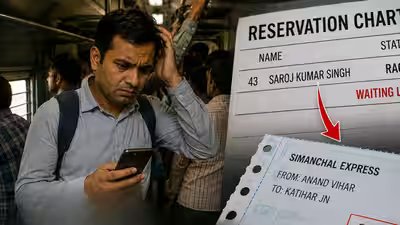
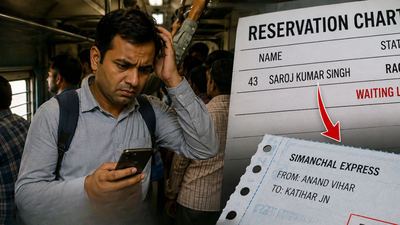
Imagine booking a train ticket with RAC status, reaching the station expecting to at least get a shared berth, and discovering at the last minute that your ticket has been pushed into the waiting list. That is exactly what happened to a Delhi passenger, who was eventually forced to travel standing- and later took Indian Railways to the consumer commission.The case, dating back to 2012, has now resurfaced after the Delhi State Consumer Disputes Redressal Commission upheld an order holding the Railways responsible for failing to properly inform the passenger about the change in his reservation status. The commission awarded him Rs 5,000 as compensation for mental agony, harassment and litigation costs.
He booked an RAC ticket- but the status changed
According to Live Law, the passenger, Saroj Kumar Singh of Uttam Nagar, Delhi, had booked a sleeper-class ticket on the Simanchal Express in October 2012. At the time of booking, his reservation status was RAC 43.For those unfamiliar with the system, an RAC ticket generally allows a passenger to board the train and travel, although the passenger may initially have to share a berth. A fully waitlisted ticket, on the other hand, does not give the passenger the same confirmed right to travel in the reserved coach.Singh expected that his RAC status could eventually improve before the journey.But when he reached Anand Vihar Railway Station at around 6.30 am on October 31, 2012, he got an unexpected shock. The reservation chart showed his status as Waiting List 44 instead of RAC 43.

File Photo
Why did the RAC ticket become waitlisted?
According to Indian Kanoon, a coach that was supposed to be attached to the train could not be used because of a technical issue. The removal of the coach reduced the number of available berths and resulted in Singh’s RAC reservation being pushed to the waiting list.The problem, however, was not simply the change in availability. The commission took particular note of the fact that Singh had not been informed about the change before he arrived at the station.When he approached railway staff and the TTE, he was reportedly told that some coaches had been removed. But by then, he had little opportunity to make alternative travel arrangements. With no berth available to him, Singh ultimately travelled standing for the journey from Anand Vihar to Katihar Junction.
Passenger approached consumer commission
Singh subsequently sent a legal notice to the Railways, arguing that he had suffered because the change in his ticket status was not communicated to him in time.The District Consumer Disputes Redressal Commission, Delhi, ruled in his favour in 2020 and directed the Railways to pay Rs 5,000 as compensation for the mental agony and harassment suffered by him, including litigation costs.The Railways challenged the decision before the Delhi State Consumer Commission. One of the arguments was that Singh did not have a confirmed berth in the first place. But the State Commission was not persuaded by that reasoning.
What the Delhi State Consumer Commission said
In its February 27, 2026 order, the State Commission said the crucial issue was the failure to provide timely information about the change in reservation status.The commission noted that the passenger learned about the change only when he reached the station and checked the reservation chart. Had he been informed earlier, he could have made alternative arrangements for his journey.The commission therefore agreed with the District Commission that the Railways had been deficient in providing the service and that the Rs 5,000 compensation was reasonable in the circumstances. It dismissed the Railways’ appeal.
What this means for train passengers
The case does not mean that every passenger whose RAC ticket fails to become confirmed is automatically entitled to compensation.The important factor here was the unexpected change from RAC to waiting list and the absence of timely communication, which left the passenger unable to make alternative arrangements.The ruling also highlights a practical point for train travellers: checking the reservation status before leaving for the station can be crucial, particularly when travelling on an RAC or waitlisted ticket.For Singh, however, the episode went beyond the usual uncertainty of railway reservations. He had started his journey believing that his RAC status gave him a reasonable chance of travelling with a berth arrangement. Instead, he discovered the change only at the station and ended up making the journey standing.More than a decade after the journey itself, the consumer commission’s decision has now given the unusual case drawn fresh attention- and a reminder that passengers may have recourse when a change in railway service leaves them without a reasonable chance to make alternative arrangements.