


Foreign assets may possibly be overlooked years later—whether it is a bank account opened while studying abroad, stocks received by domestic employees under Company’s Employee Stock Option plans (ESOPs) or Restricted Stock Units (RSUs), savings accumulated during an international assignment, an overseas brokerage account, contributions to foreign pension or retirement plans, or property acquired while living abroad.Global information-sharing frameworks have made overseas assets far more visible to the Indian tax authorities. Through the Common Reporting Standard, the Foreign Account Tax Compliance Act, Automatic Exchange of Information arrangements and other information-exchange mechanisms, the Income tax department receives information on taxpayers’ overseas financial accounts and foreign investments.The visibility of such information is also increasing from the taxpayer’s perspective. Pursuant to a CBDT order issued on 8 July 2026, information relating to foreign income and assets received from overseas tax authorities under information-exchange arrangements is being reflected in tax compliance systems such as the Annual Information Statement and related reporting utilities. This marks a significant shift from the earlier position where these systems primarily focused only on domestic tax information.The Explanatory Memorandum to the Finance Bill, 2026 states that information received through international exchange frameworks has identified taxpayers inadvertently missed to disclose foreign financial assets in their India tax returns. However, Finance Minister also clarified in the budget speech earlier this year, that such omissions do not necessarily amount to deliberate tax evasion. Individuals may have acquired such assets while studying, working or living overseas and later become Tax Residents of India. The income may already have been taxed, or the assets may have been acquired while they were Non-Residents, but the disclosure in Schedule Foreign Assets (‘FA’) of the Income Tax Return (‘ITR’) may have been missed.The Foreign Assets of Small Taxpayers – Disclosure Scheme (‘FAST-DS’ or ‘Scheme’) was announced in the Union Budget 2026. The Scheme was notified on 14 August 2026 and came into effect on 16 August 2026. Eligible taxpayers can make declarations of miss outs (as explained above) until 31 December 2026.The scheme provides a one-time opportunity to address specified foreign income and foreign asset reporting gaps. It covers two situations: (a) undisclosed foreign income or assets that meet the prescribed conditions; and (b) foreign assets with an explained source that were not reported in the Schedule FA of the ITR. We have discussed both situations in brief, with a few examples.The above distinction is central to FAST-DS, as it directly determines the amount payable and the relief available. Taxpayers who have historically failed to disclose overseas accounts, foreign securities, pension corpus or other eligible foreign assets now have a one-time limited window to regularise these reporting gaps.
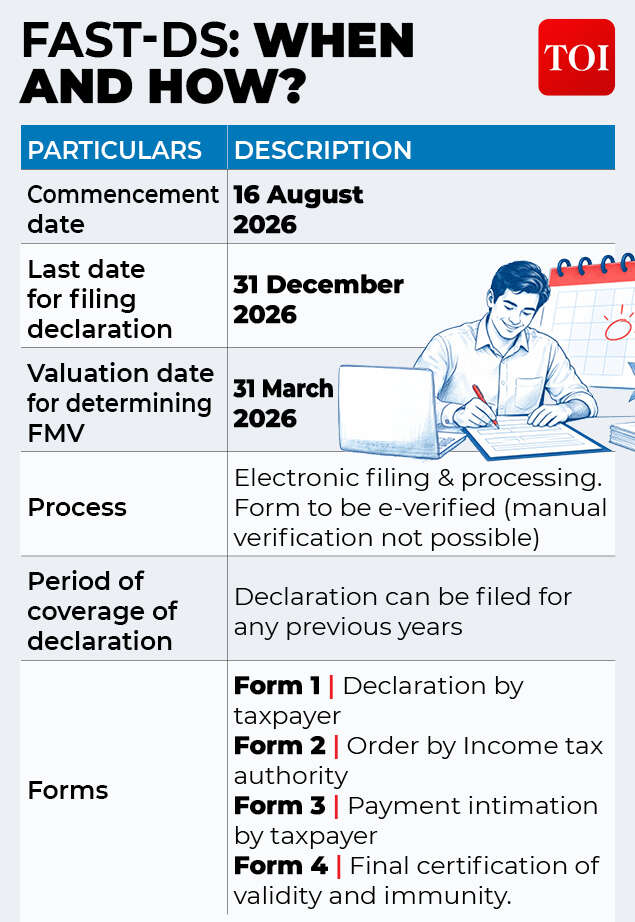
FAST-DS: When and How?
Why does the scheme matter?
A foreign asset reporting lapse does not always mean there is undisclosed income or wealth. A taxpayer may have paid tax on foreign ESOP/ RSU, interest earned in foreign bank account etc. but failed to report the resulting overseas shareholding, foreign bank account details in Schedule FA of the ITR. Similarly, an individual may continue to hold a foreign bank account funded while a Non-Resident. In both cases, the source of the asset may be legitimate and fully explainable, but the reporting obligation may have been missed.FAST-DS addresses this distinction directly. It separates undisclosed foreign income or assets from foreign assets whose source is already explained but which were not reported. This distinction is vital to the scheme because it determines the eligibility, amount payable and the relief available to the taxpayer.
What does it cost to declare?
FAST-DS divides eligible taxpayers into two broad categories as explained below. The scheme applies where a taxpayer failed to report foreign income or an asset in his/ her ITR. Eligibility must first be determined, including whether the relevant assessment year has already been assessed under the Black Money (Undisclosed Foreign Income and Assets) and Imposition of Tax Act, 2015(‘BMA’); if so, the scheme may not be available.For eligible cases, the nature of the lapse determines the applicable FAST-DS category and amount payable.FAST-DS separates unexplained foreign income or assets acquired and those acquired from explained sources but not reported. Each Category has different thresholds and requirements of payment of tax.
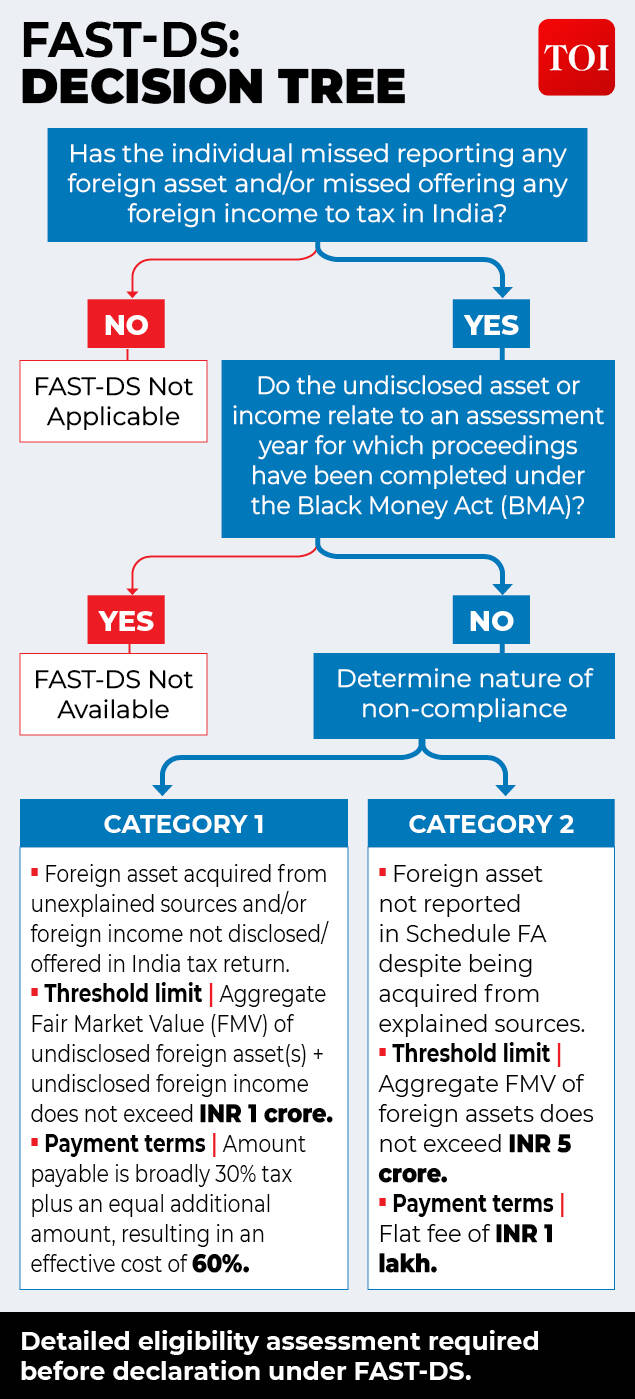
FAST-DS: Decision making tree to understand
Illustrative impact under the two Categories
The financial implications under the two Categories differ significantly. A simplified illustration is set out below:
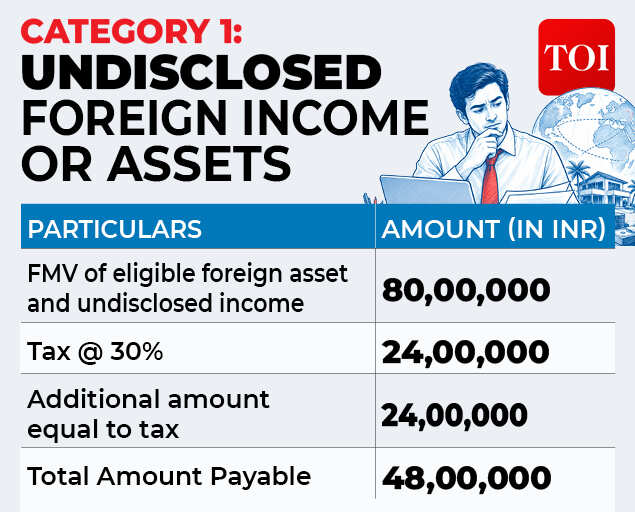
Undisclosed foreign income or assets
As the illustration shows, the effective cost under Category 1 can equal 60% of the asset’s FMV and undisclosed income. The scheme therefore offers a path to regularisation, but at a substantial cost.
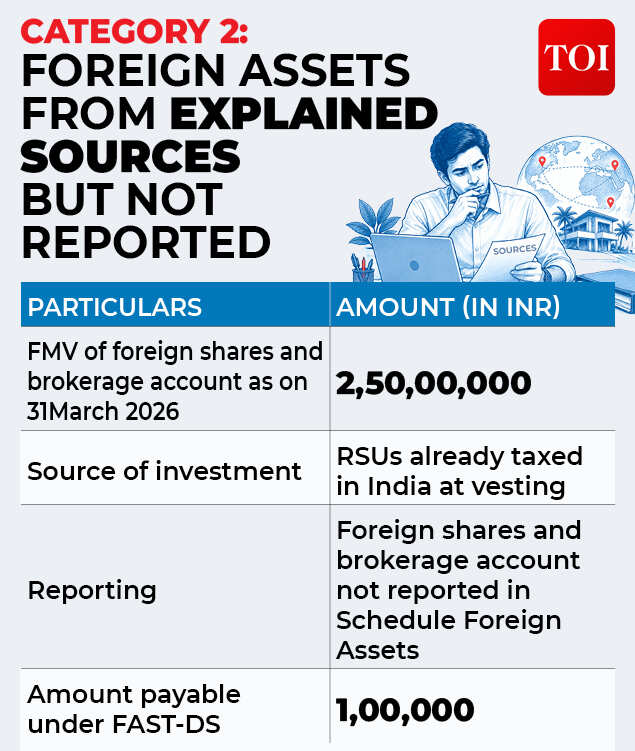
Foreign assets from explained sources but not reported
In this example, the lapse concerns only the failure to report the foreign asset. Subject to the prescribed conditions, a flat fee of INR 1 lakh applies.
Who should take a closer look?
FAST-DS can apply where a taxpayer failed to report foreign income or assets in an ITR or did not file an ITR despite being required to do so. Subject to the prescribed thresholds, conditions and exclusions, it can apply to any previous year(s).Importantly, the scheme is not restricted to individual taxpayers who are currently Resident in India. Even if a person subsequently became a Non-Resident or Resident and Not Ordinarily Resident, the scheme will still be applicable where the foreign income or assets relates to a year in which the individual qualified as a Tax Resident in India and the relevant reporting obligation was not met.Eligibility therefore needs to be assessed based on the relevant facts, the nature of the foreign asset or income, and the specific conditions of the scheme.
Navigating the valuation mechanism
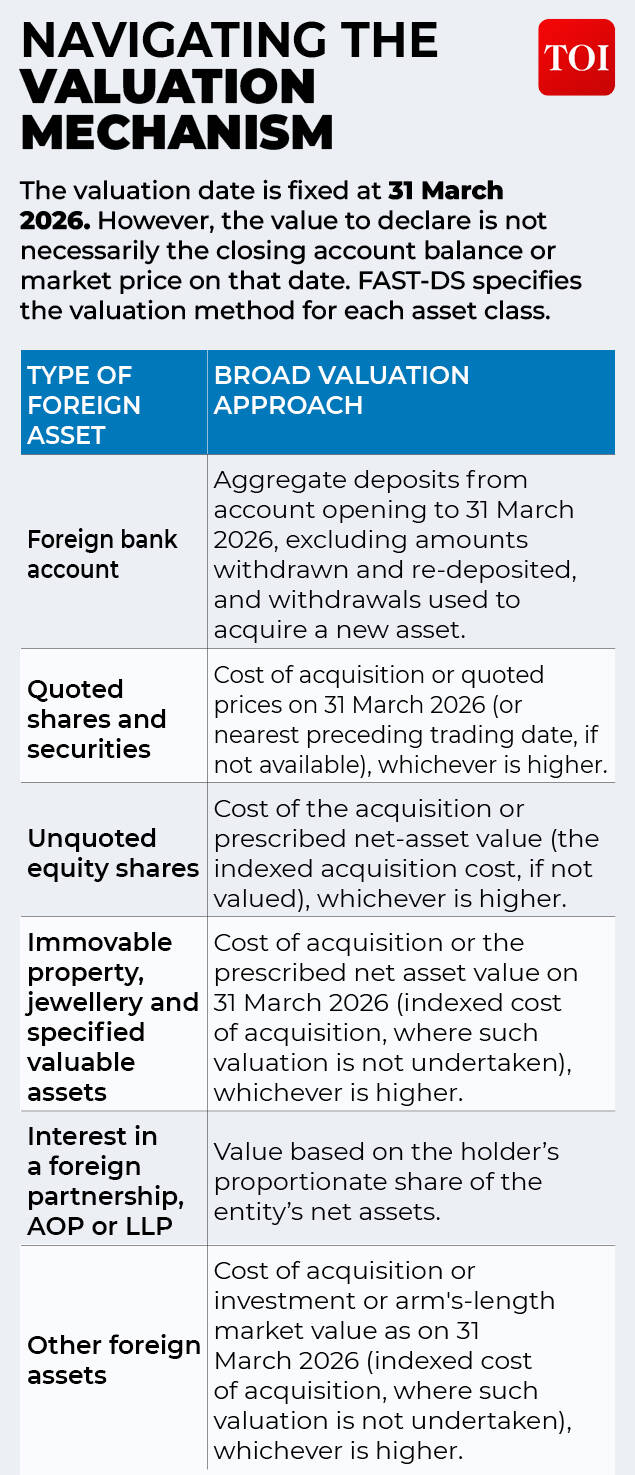
Navigating the valuation mechanism
The above table provides a simplified overview. The detailed rules, valuation formulas and documentary requirements must be applied to the particular asset given in the Scheme and FAQs. From declaration to certificationPlease find below step-by-step guide of stages from declaration to clearance certificate:
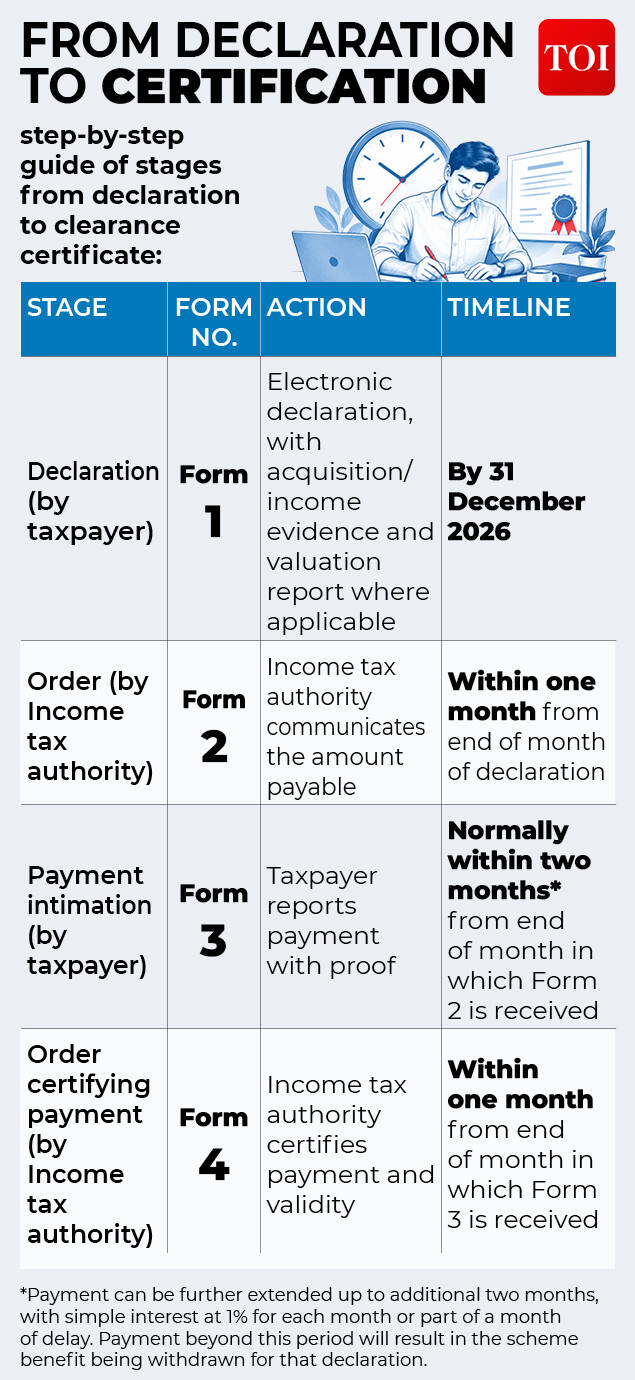
From declaration to certification
Is it a blanket amnesty?
FAST-DS offers taxpayers certainty. Once a taxpayer makes a valid declaration, pays the prescribed amount and meets the scheme conditions, the disclosed foreign income or asset is regularised. The taxpayer is protected from further tax, penalty and prosecution under the BMA for the income or asset covered by the declaration. The same income or investment amount is also not taxed again under the Income tax Act, 1961 or the BMA.Having said the above, FAST-DS is not a blanket amnesty. It applies only to income and assets that are fully and accurately disclosed. Any material misrepresentation or suppression of facts can make the declaration void and result in loss of the scheme’s protection. Amounts paid under the scheme are non-refundable, so taxpayers should carefully assess eligibility, classification and valuation before filing.There is, however, a limited safeguard in relation to valuation. For assets other than foreign bank accounts, a valuation difference of up to 20% will not, by itself, invalidate the declaration for misrepresentation or suppression.The scheme also does not cover serious cases involving criminal proceeds. It is unavailable where the foreign income or asset represents proceeds of crime and proceedings under the Prevention of Money-laundering Act, 2002 have been initiated or are pending. FAST-DS also cannot be used for years already assessed under the BMA.Importantly, the immunity under FAST-DS is limited to tax, penalty, and prosecution under the BMA for the income or asset declared. It does not automatically extend to other applicable laws or regulatory frameworks.In short, FAST-DS gives eligible taxpayers a clear route to correct foreign-asset reporting lapses, provided the disclosure is complete and accurate.
Checklist to consider before filing
Prior to filing under FAST-DS, taxpayers should undertake a comprehensive review to map each foreign asset to the relevant assessment year, applicable reporting obligation, and source of funds to accurately identify the nature and extent of any lapse. This review should also assess the consistency of supporting documentation across tax returns, account statements, and valuation records. Any discrepancies or documentation gaps should be addressed at the earliest opportunity, particularly where historical overseas records may need to be reconstructed or obtained from foreign institutions.Lastly, before filing under FAST-DS, taxpayers should confirm that the relevant year has not been assessed under the BMA by reviewing any related notices and orders issued.A smooth declaration process requires supporting documentation (indicative only) such as:
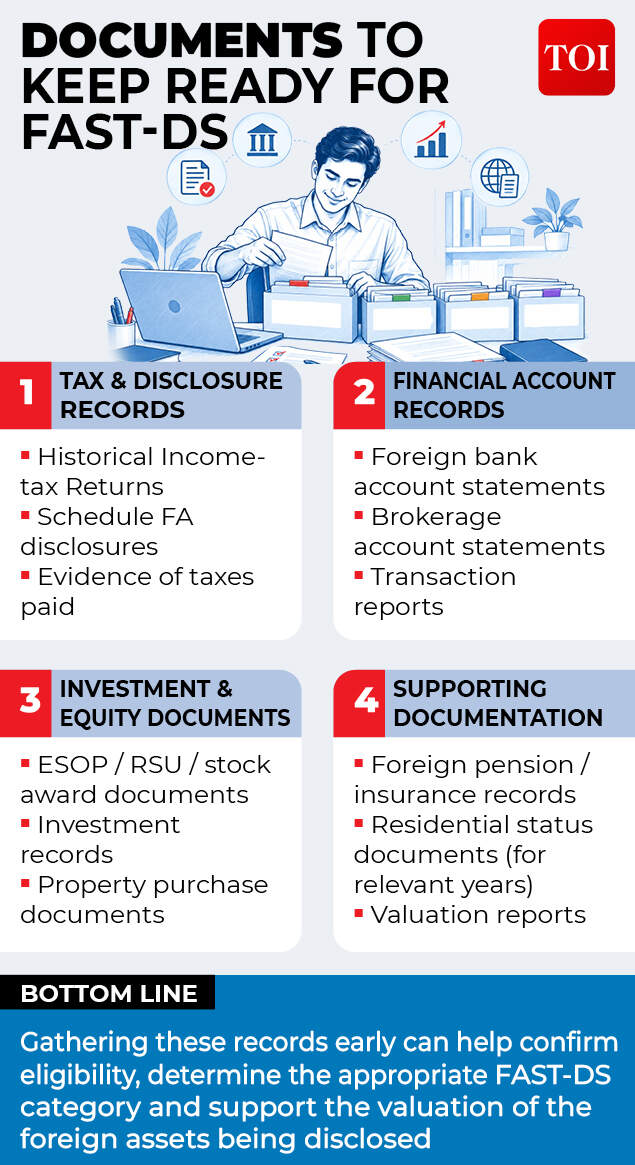
Documents to keep ready for FAST-DS
The real takeaway
FAST-DS reflects the tax authorities’ progressive approach to strength foreign asset and income reporting. Following the BMA, enhanced international information exchange, greater visibility of overseas information in tax systems and CBDT’s NUDGE campaigns, the emphasis has moved from identifying reporting gaps to familiarising and educating taxpayers before imposing harsher consequences.As global information flows and data-analytics capabilities expand, historical reporting gaps are likely to face greater scrutiny. FAST-DS therefore provides eligible taxpayers with a limited, one-time opportunity to regularise past non-compliance, subject to the prescribed conditions.The broader message is clear: the period of taxpayer education and voluntary correction seems to be getting over, and unresolved gaps may attract closer scrutiny, stringent action with penal repercussions.(Ravi Jain is Tax Partner at Vialto. Vikas Narang, Director, and Pawan Digga, Manager at Vialto, have also contributed to this article. Views are personal)