


The author is CEO of PaisabazaarFor many, saving tax has long been one of the key reasons for investing in tax-saving instruments. These instruments have helped Indians not only reduce their tax liability but also build wealth and provide financial security to their families. But with the introduction of the new tax regime, with its lower tax rates and a higher standard deduction, taxpayers are increasingly shifting towards the new tax regime.In fact, around 88% of individual taxpayers have already shifted to the new system. This shift also signals departure from conventional tax-saving strategies as the new tax regime does not offer several tax deductions and exemptions available under the old tax regime. While these usual go-to avenues may have lost some of their appeal as tax-saving instruments, they still hold great financial value in terms of long-term financial security.Here are some of the tax-saving instruments that still deserve a place in your long-term wealth strategy, even without the tax break.
1. Life Insurance
Many taxpayers view life insurance as a tax-saving tool, but its value is far greater. It offers financial protection to your family in the event of unforeseen circumstances. It ensures your family do not struggle to manage everyday expenses, repay outstanding dues or meet long-term goals in your absence.Why should you invest:Financial stability for your family: A life cover can provide financial support that gives your family time to adjust to a major change in the household’s finances without having to immediately compromise their standard of living.Protection of accumulated wealth or assets: Adequate life cover can help ensure that a family does not have to prematurely sell investments or other assets to meet immediate financial needs following the death of an earning member.Liability management: Life insurance can provide a dedicated source of funds to meet outstanding loans and other financial liabilities, helping prevent these obligations from becoming a burden on the family.Note that your life cover should be at least 15-20 times your annual income. However, the right cover should also take into account your outstanding loans, number of dependents, children’s education and other long-term financial commitments. A new-regime taxpayer should not discontinue their life insurance merely because the tax deduction is unavailable. The absence of a tax benefit can make it even more important to assess a policy on the basis of the protection it provides, its cost and its suitability.
2. Health Insurance
A sound financial plan should not stop at growth-oriented and tax-saving investments. Whether you are following the new tax regime or the old one, the focus of individuals should always be on building a financial plan that protects their family, wealth and financial goals. To ensure this, including health insurance in your financial plan is a must because its primary purpose is not wealth creation or tax saving, but protecting your savings from the financial impact of unexpected medical costs.Why should you invest:Protection of your savings: Adequate health insurance can help cover eligible medical expenses, reducing the need to use your savings to pay for hospitalisation and treatment costs.Protection of long-term financial goals: A large medical expense can derail important goals such as retirement planning, children’s education or buying a home. Health insurance can help reduce the financial impact of such unexpected expenses.Financial security during medical emergencies: Health insurance can provide financial support when you or your family members need medical treatment, helping you manage healthcare costs without putting your overall financial plan under undue pressure.The right sum insured for your health cover should be decided on factors such as the number of family members covered, their age and health conditions, your location and the level of medical expenses you may need to meet. Also, assess your financial health and choose the sum insured accordingly.
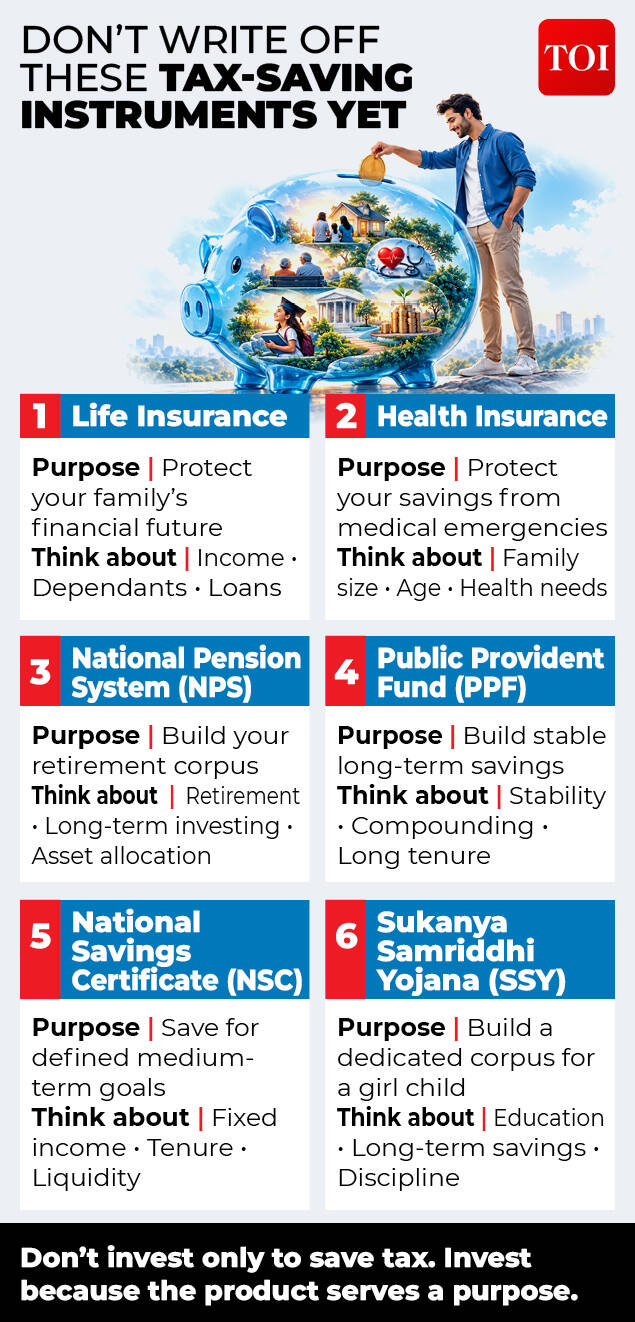
Tax saving instruments that are still relevant
3. National Pension System (NPS)
The new tax regime has eliminated most deductions, but the two key deductions remained – the Rs 75,000 standard deduction, which requires no action and the employer NPS contribution, which must be considered carefully. In this, your employer pays a part of your salary directly into your NPS Tier 1 account and that contribution is exempt from your taxable income – up to 14% of your salary under the new regime or 10% under the old regime for private-sector employees.Why should you invest:Retirement planning: NPS is specifically designed to help individuals build a corpus for their post-retirement years, making it different from investments meant for short- or medium-term goals.Long-term investing: Its design encourages investors to build a retirement corpus over an extended period and to ensure that it comes with restrictions on premature withdrawals.Asset diversification: It offers investment choices across different asset classes, allowing subscribers to build a diversified retirement portfolio rather than relying on a single type of investment based on their risk appetite.New-regime tax benefit: Employer contributions of up to 14% of basic salary can qualify for tax benefits under the new tax regime.
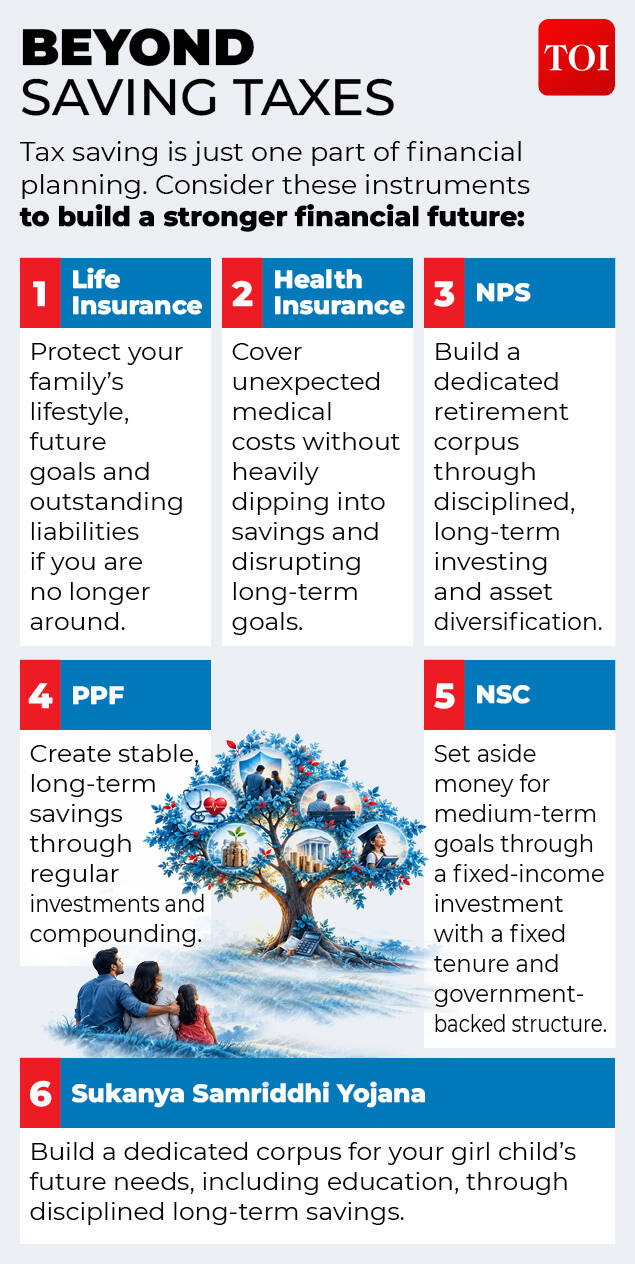
6 things to consider beyond tax saving
4. Public Provident Fund (PPF)
PPF may not have the growth of equity investing, but it remains one of the best avenues for long-term stable returns. Offering a government-backed 7.1% p.a. interest rate, PPF provides guaranteed, tax-free returns, making it a perfect addition for risk-averse investors and those seeking stability near retirement.Why should you invest:Capital protection: PPF can appeal to investors looking for a government-backed small-savings avenue rather than taking on the market risk associated with equity investments.Long-term compounding: Its 15-year long tenure allows investors to remain invested for an extended period, giving their contributions the opportunity to accumulate through compounding.Disciplined investing: Its long-term structure and withdrawal restrictions can encourage investors to keep money earmarked for future needs instead of using it for short-term expenses.Portfolio diversification: Someone with substantial exposure to market-linked investments can consider PPF as part of the relatively stable portion of their long-term portfolio.Tax-free earnings: PPF’s interest and maturity is completely tax-free under both the old and the new tax regimes.
5. Savings Schemes – NSC & SSY
National Savings Certificate (NSC)For investors who prefer the relative stability of fixed-income investments, market-linked products can sometimes feel too unpredictable, particularly when the money is earmarked for a defined financial goal. This is where NSC can still find a place in a portfolio. With a fixed tenure and government-backed small savings framework, NSC can help investors set aside money without directly exposing it to equity-market fluctuations. It also encourages investors to stay invested by not permitting premature encashment, except in specified circumstances such as the account holder’s death.Why should you invest:Fixed-income stability: can suit investors looking for a government-backed small-savings avenue with a defined tenure, rather than an equity-market-linked investment.Goal-based investing: Its fixed maturity period can be useful when an investor has a medium-term financial goal and wants to earmark money separately for it.Reinvestment of interest: The interest earned on NSC is compounded and reinvested, allowing the investment to grow over the tenure rather than relying only on the initial principal.However, liquidity needs should be considered before investing because NSC does not offer the same level of flexibility as a regular savings account or easily redeemable market-linked investment.Sukanya Samriddhi Yojana (SSY)The SSY is designed specifically for long-term savings for the benefit of a girl child. It is part of the government’s small savings schemes. The scheme encourages disciplined savings over several years, helping parents build a dedicated corpus for future goals such as higher education. Its long-term structure also reduces the temptation to use these savings for short-term expenses, making it a goal-oriented investment.Why should you invest:Child-focused savings: It provides a dedicated avenue for building savings for a girl’s future financial needs. Its rules around withdrawals also ensures the money is not used towards routine or short-term expenses.Long-term wealth accumulation: The scheme is structured around long-term savings, making it more appropriate for goals that are several years away.Dedicated goal bucket: Keeping child-related savings separately can make it easier to avoid using those funds for unrelated expenses.Disciplined contributions: The scheme’s rules and long-term structure encourage regular contributions, helping parents build the corpus gradually rather than having to arrange a large amount closer to the child’s education or other major milestones.ConclusionThe new tax regime has changed the tax-saving equation, but it has not made every tax-saving instrument irrelevant. Even if significant taxpayers have shifted to the new regime, the above instruments can continue to be the critical pillars of a smart, long-term financial strategy.For taxpayers who may choose between the old and new regimes, the decision should also be based on their overall income, eligible deductions, exemptions and financial circumstances rather than on any single investment.On the other hand, taxpayers following the new regime should look beyond the tax deduction and assess each investment and insurance product according to what it offers and whether it fits into their financial plan or helps them achieve their goals or not. For instance, PPF and NSC can play a role in long-term and fixed-income-oriented wealth creation. SSY can support an eligible girl child’s long-term financial goals. NPS can contribute towards investors’ retirement planning. And insurance, both life and health, are crucial for financial security of your loved ones and protects your investments and savings in unforeseen circumstances.(Disclaimer: Recommendations and views on the stock market, or any other asset classes or personal finance management tips given by experts and analysts are their own. These opinions do not represent the views of The Times of India.)