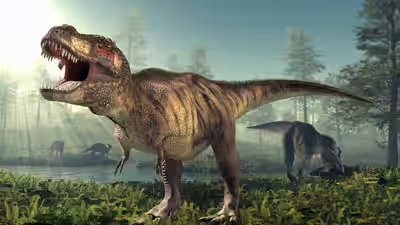
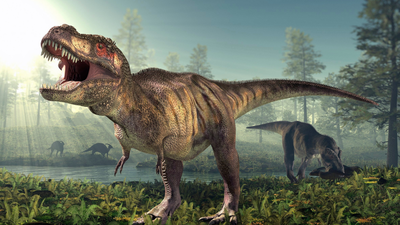
Tyrannosaurus rex has been known as the most dangerous dinosaur for decades, and our picture of the giant beast has been built almost entirely from bones, skulls, ribs, teeth, and skeletons carefully pieced together in museums.Bones tell us what the animal looked like, how big it was, and even what it might have eaten. But they can’t tell us how it actually moved through the world it lived in. Footprints can.And until recently, footprints from a fully grown T. rex were almost nonexistent.
Scientists discover footprints of a fully grown T. Rex for the first time
For the first time, paleontologists have discovered what they believe is a genuine trackway left by a fully grown Tyrannosaurus rex, a rare set of four connected footprints that finally lets researchers study how this massive predator actually moved.The footprints were found in the badlands of southwestern North Dakota, close to the Montana border, in the Hell Creek Formation. According to a report by The Guardian, until this discovery, only two confirmed adult T. rex footprints had ever been found anywhere in the world, one in New Mexico and one in Montana, and both were isolated prints that revealed nothing about movement.
The only T. rex footprints that are a connected trail
This new find is different because it’s a connected trail, not a single mark. The discovery is detailed in a new paper published in the Journal of Vertebrate Paleontology. As Tyler Lyson, senior curator of vertebrate palaeontology at the Denver Museum of Nature & Science, explained in a statement, “Bones tell us an enormous amount about these animals, but footprints capture a moment of behaviour. With a trackway, we can actually follow an animal as it moves across the landscape. That is incredibly rare for T rex.”The footprints, dated to around 66.5 million years ago, were found on federal land near Marmarth, North Dakota. Each print measures roughly 3 feet long, with about 13 feet of distance between each step. Researchers say the size and shape of the prints strongly suggest an adult T. rex as the trackmaker.
The footprints were thoroughly scanned and visualised
To study the footprints without damaging them, the team used high-resolution 3D scanning technology to digitally recreate and examine the tracks remotely. According to Peter Falkingham, professor of paleobiology at Liverpool John Moores University and lead author of the study, “The technology we’re able to apply in the digital age means my colleagues could scan the tracks in the field and then send the 3D information over to me to visualise on my computer and in VR, enabling me to take as close a look as they did in person.“Based on the spacing between the footprints, researchers estimated the dinosaur was moving at roughly 3.5 to 4.5 mph, similar to a brisk human walk.Despite T. rex’s fearsome reputation, the tracks suggest this particular animal was simply walking, not sprinting, when it left the impressions behind. These speed estimates are not exact, considering the erosion of footprints through the years.