
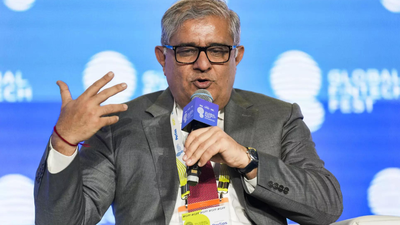
MUMBAI: Under Amitabh Chaudhry, who has headed Axis Bank for seven-and-a-half years, the bank delivered an 18% ROE for nearly seven quarters. However, the retail cycle, higher credit costs and rate cuts put pressure on NIMs. In an interview with TOI, Chaudhry spoke about how 18% ROE remains a target, though it is aspirational and difficult to achieve.n You will be completing your third three-year term next year. What has been achieved and what is left to be done?From strengthening the brand, improving net promoter score and upgrading businesses and subsidiaries, I am satisfied with what we have achieved. But the unfinished agenda is larger than I thought a few years ago: deeper penetration, premiumisation, consistent performance, stronger deposits and capitalising on AI. Execution remains critical. Covid and the retail cycle tested us along the way. We have moved ahead of competition in payments, with strong UPI and merchant-acquisition shares and a stronger credit card franchise after Citi acquisition. We have also built the third-largest wealth franchise in four years. Retail quality has improved but remains a work in progress.Will you have to trade growth for margins?It would be the wrong approach to say, “I can either fix growth or NIMs.” We can do both. Our size is not yet so large that if I have to work too much on NIMs, I have to sacrifice something else. There are times when market dynamics or external factors could impact our margins, but in the medium-to-long term, we believe we can deliver 3.8% without too much of a problem.Has Citi acquisition delivered?It has delivered. The deposit/advance portfolios, synergies and talent benefits we expected have materialised. We also received an unexpected Rs 2,000-2,300 crore tax benefit, effectively lowering the acquisition price. It strengthened our credit card and wealth franchises and added deposits when they were becoming a constraint. Given the effort required even for a small acquisition, we now believe acquisitions should be big enough to justify that effort.So you are open to growing inorganically?We are always open. We have never shied away from it. The right one needs to come along at the right price. If you look at our size, HDFC is more than double ours. We are a decent franchise with a great set of customers. If the right one comes along, we will look at it.Do you think banks have missed the bus on UPI?When people discuss UPI market share, they focus on front-end apps; banks provide the rails. Every transaction relies on banks for authorisation, funding, fraud checks, disputes, regulatory liability and customer money. Apps spent heavily to acquire customers when UPI launched, then leveraged that base to build other businesses. MDR (merchant fees) and transaction data give banks scope to underwrite, understand and reach customers better, creating a potential advantage. Axis has 35% share of the rails it provides and 20% as an issuer, making it a major player. MDR should help make UPI self-sustaining without charging consumers, while NPCI is adding more use cases to make the infrastructure more useful.But customers who earlier did not need to visit banks because of mobile and internet banking now don’t need to visit the app, because large payments can be made through UPI. How do you remain relevant?UPI covers payments, but banking offers a far wider suite of services. With MDR potentially creating revenue, banks will compete harder for payments, and we are well placed with our existing share. The same shift is happening in brokerage and mutual funds.